Advertisements
Advertisements
प्रश्न
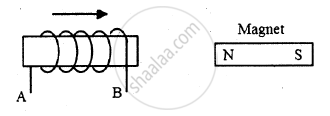
In the following diagram an arrow shows the motion of the coil towards the bar magnet.
(1) State in which direction the current flows, A to B or B to A?
(2) Name the law used to come to the conclusion.
Advertisements
उत्तर
(1) The direction of current in the coil is from A to B.
(2) The law used is the Lenz’s law of electromagnetic induction.
The coil is moving towards the North Pole of the magnet. Due to this, there is a change in magnetic flux in the coil. Now, the direction of induced e.m.f. (induced current) is such that it opposes this change in flux. Hence, the right end of the coil should also behave as North Pole. Hence, the current will be in the anti-clockwise direction, i.e., from A to B.
संबंधित प्रश्न
State Lenz’s Law.
- Describe briefly one way producing an induced e.m.f?
- State one factor that determines the magnitude of induced e.m.f. in part (a) above.
- What factor determines the direction of induced e.m.f. in part (a) above?
What is Lenz’s law?
The instantaneous magnetic flux in a circuit is `phi=4t^2-4t+1`. The total resistance of circuit is 15 Ω. At t = 2s, the induced current in circuit is ____________.
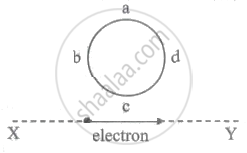
An electron moves on a straight line path XY as shown. The abed is a coil adjacent to the path of electron. What will be the direction of current, if any, induced in the coil?
A circular loop is placed in a uniform magnetic field. The total number of magnetic field lines passing normally through the plane of the coil is called ______.
What happens to magnetic flux through a coil when a magnet is brought closer to it?
Which condition is a limitation of Faraday’s First Law or Neumann’s law?
What does the negative sign in Faraday’s First Law indicate?
If the magnetic field across a loop decreases to zero, what is the final magnetic flux through the loop?
