Advertisements
Advertisements
Question
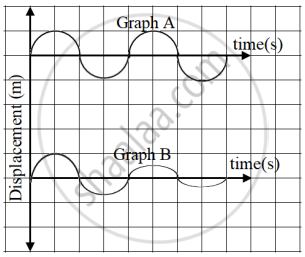
(a) Which one of the following graphs A or B shows free vibrations in a vacuum and which one shows free vibrations in a medium?
(b) How did you come to this conclusion.
Advertisements
Solution
- Graph A represents free vibration in a vacuum and Graph B represents free vibration in the medium.
- For free vibrations in a vacuum, there is no resisting force, thus the amplitude will remain the same with time. Whereas for free vibrations in a medium there is always a resistive force, thus the amplitude reduces with time due to this resistive force.
APPEARS IN
RELATED QUESTIONS
State the ways by which the frequency of transverse vibrations of a stretch string can be increased.
Give one reason for Ultrasonic waves use for echo depth sounding purpose.
Draw a graph between displacement and the time for a body executing free/natural vibrations.
What do you understand by free vibrations of a body?
State two ways of increasing the frequency of vibrations of a stretched string.
A wire stretched between two fixed supports, is plucked exactly in the middle and then released. It executes (neglect the resistance of the medium) ______.
Two astronauts cannot hear each other on the moon. Why?
Explain why strings of different thicknesses are provided on a stringed instrument.
