Advertisements
Advertisements
प्रश्न
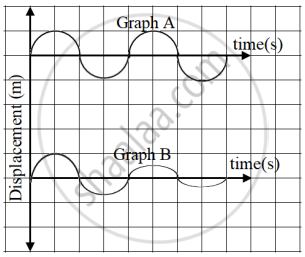
(a) Which one of the following graphs A or B shows free vibrations in a vacuum and which one shows free vibrations in a medium?
(b) How did you come to this conclusion.
Advertisements
उत्तर
- Graph A represents free vibration in a vacuum and Graph B represents free vibration in the medium.
- For free vibrations in a vacuum, there is no resisting force, thus the amplitude will remain the same with time. Whereas for free vibrations in a medium there is always a resistive force, thus the amplitude reduces with time due to this resistive force.
APPEARS IN
संबंधित प्रश्न
Why are the Ultrasonic waves are not audible to us?
What do you understand by free vibrations of a body?
- Name one factor on which the frequency of sound emitted due to vibrations in an air column depends.
- How does the frequency depend on the factor stated in part (a).
State two ways of increasing the frequency of vibrations of a stretched string.
Explain why strings of different thicknesses are provided on a stringed instrument.
[Hint: Natural frequency of vibration of a stretched string is inversely proportional to the radius (or thickness) of string so notes of different frequencies can be produces by vibrating different strings.]
A blade, fixed at one end, is made to vibrate by pressing its other end and then releasing it. State one way in which the frequency of vibrations of the blade can be lowered.
A wire stretched between two fixed supports, is plucked exactly in the middle and then released. It executes (neglect the resistance of the medium) ______.
Explain why does a wine glass starts rattling, when a note of some particular frequency is struck by a piano?
Explain why strings of different thicknesses are provided on a stringed instrument.
