A Ray of Light Falls on a Transparent Sphere with Centre C as Shown in the Figure. the Ray Emerges from the Sphere Parallel to the Line Ab.
Advertisements
Question
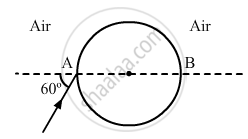
A ray of light falls on a transparent sphere with centre C as shown in the figure. The ray emerges from the sphere parallel to the line AB. Find the angle of refraction at A if the refractive index of the material of the sphere is \[\sqrt{3}\].
Advertisements
Solution
From Snell's law, we have: \[\frac{\sin\left( i \right)}{\sin\left( r \right)} = \mu\] At A, i = 60° (given)
Now, μ = √3
\[\Rightarrow \sin\left( r \right) = \frac{\sin\left( i \right)}{\mu}\]
\[ \Rightarrow \sin\left( r \right) = \frac{\sin\left( 60° \right)}{\sqrt{3}} = \frac{1}{2}\]
\[ \Rightarrow r = \sin^{- 1} \left( \frac{1}{2} \right)\]
\[ \therefore r = 30°\]
RELATED QUESTIONS
A slab of material of dielectric constant K has the same area as the plates of a parallel plate capacitor but has a thickness \[\frac{3d}{4}\]. Find the ratio of the capacitance with dielectric inside it to its capacitance without the dielectric.
A parallel-plate capacitor has plate area 20 cm2, plate separation 1.0 mm and a dielectric slab of dielectric constant 5.0 filling up the space between the plates. This capacitor is joined to a battery of emf 6.0 V through a 100 kΩ resistor. Find the energy of the capacitor 8.9 μs after the connections are made.
In a parallel plate capacitor, the capacity increases if ______.
A parallel plate capacitor is connected to a battery as shown in figure. Consider two situations:

- Key K is kept closed and plates of capacitors are moved apart using insulating handle.
- Key K is opened and plates of capacitors are moved apart using insulating handle.
Choose the correct option(s).
- In A: Q remains same but C changes.
- In B: V remains same but C changes.
- In A: V remains same and hence Q changes.
- In B: Q remains same and hence V changes.
For two plates separated by distance \[d\], what is the capacitance of a parallel plate capacitor without a dielectric medium?
Substituting \[V=\frac{Qd}{\varepsilon_0 A}\] into \[C=\frac{Q}{V}\] gives which capacitance?
What is the effect of inserting a dielectric with \[K>1\] between the plates?
Which description gives the working principle of a parallel plate capacitor?
Where is electrical energy stored in a parallel plate capacitor, and how can it be used?
In electronic circuits, what are filters and oscillators used for?
