Advertisements
Advertisements
प्रश्न
Figure 4 below shows a capacitor C, an inductor L and a resistor R, connected in series
to an a.c. supply of 220 V
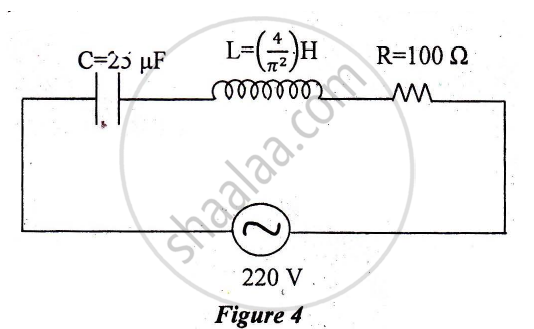
Calculate:
1) The resonant frequency of the given CLR circuit.
2) Current flowing through·the circuit.
3) Average power consumed by the circuit.
Advertisements
उत्तर
`E_"rms" = 220 V`
`C = 25 muF`
`L = (4/pi^2)H`
R = 100 Ω
1) Resonant Frequency
`f_r = 1/(2pisqrt(LC))`
`= 1/(2xx 3.14 xx sqrt(4/pi^2 xx 25 xx 10^(-6)))`
`= 1/(2xx3.14 xx 2/3.14 xx 5 xx 10^(-3)) `
= 50 Hz
2) Inpedance (Z) = `sqrt(R^2 + (X_L - X_C)^2)`
`X_L = 127.3 Ω, X_C = 127.3 Ω`
Z = `sqrt(100^2 + (127.3 - 127.3)^2 )`
`Z = sqrt(100^2)`
Z = 100 Ω
`I_"rms" = E_"rms"/2`
`= 220/100`
`I_"rms" = 2.2 A`
3) Average power consumed by the circuit
Power = `E_"rms" xx I_"rms" xx R/sqrt(R^2 + (Lomega - 1/(Comega)))`
z = R
∴ Power = `E_"rms" xx I_"rms"`
Power = 484 watt
APPEARS IN
संबंधित प्रश्न
Three capacitors each of capacitance 9 pF are connected in series.
- What is the total capacitance of the combination?
- What is the potential difference across each capacitor if the combination is connected to a 120 V supply?
A cylindrical capacitor has two co-axial cylinders of length 15 cm and radii 1.5 cm and 1.4 cm. The outer cylinder is earthed and the inner cylinder is given a charge of 3.5 µC. Determine the capacitance of the system and the potential of the inner cylinder. Neglect end effects (i.e., bending of field lines at the ends).
The plates of a parallel-plate capacitor are given equal positive charges. What will be the potential difference between the plates? What will be the charges on the facing surfaces and on the outer surfaces?
A parallel-plate capacitor has plates of unequal area. The larger plate is connected to the positive terminal of the battery and the smaller plate to its negative terminal. Let Q, and Q be the charges appearing on the positive and negative plates respectively.
A parallel-plate capacitor is connected to a battery. A metal sheet of negligible thickness is placed between the plates. The sheet remains parallel to the plates of the capacitor.
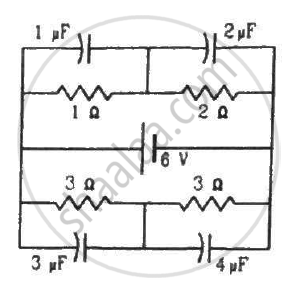
Find the charges on the four capacitors of capacitances 1 μF, 2 μF, 3 μF and 4 μF shown in the figure.
Three capacitors each of 4 µF are to be connected in such a way that the effective capacitance is 6µF. This can be done by connecting them:
The total charge on the system of capacitors C1 = 1 µF, C2 = 2 µF, C3 = 4 µF and C4 = 3 µF connected in parallel is ______. (Assume a battery of 20 V is connected to the combination)
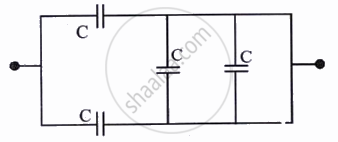
The equivalent capacitance of the combination shown is:
What is the voltage relationship for capacitors in parallel?
