Advertisements
Advertisements
प्रश्न
A resistance R is to be measured using a meter bridge. Student chooses the standard resistance S to be 100Ω. He finds the null point at l1 = 2.9 cm. He is told to attempt to improve the accuracy. Which of the following is a useful way?
विकल्प
He should measure l1 more accurately.
He should change S to 1000Ω and repeat the experiment.
He should change S to 3Ω and repeat the experiment.
He should give up hope of a more accurate measurement with a meter bridge.
Advertisements
उत्तर
He should change S to 3Ω and repeat the experiment.
Explanation:
⇒ `R = S(l_1/(100 - l_1)) = 100 2.9/97.1` = 2.98Ω
In this problem, the balanced Wheatstone bridge is to be used.
Condition of balanced wheatstone bridge: The bridge is said to be balanced if the ratio of the resistances in the same branch is equal `R/S = (l_1/(100 - l_1))`
Wheatstone bridge is an arrangement of four resistances which can be used to measure one unknown resistance of them in terms of rest.
The percentage error in R can be minimised by adjusting the balance point near the middle of the bridge, i.e., when l, is close to 50 cm. This requires a suitable choice of S.
Since, `R/S = (l_1/(100 - l_1))`
Since here, R : S = 2.9 : 97.1 then the value of S is nearly 33 times that of R. In order to make this ratio 1:1, it is necessary to reduce the value of S almost 1/33 times, i.e., nearly 3Ω.
APPEARS IN
संबंधित प्रश्न
In Wheatstone’s meter-bridge experiment, the null point is obtained in the middle one-third portion of the wire. Why is it recommended?
State any two sources of errors in the meter-bridge experiment. Explain how they can be minimized.
Four resistances 4 Ω, 8Ω, XΩ and 12Ω are connected in a series to form Wheatstone’s network. If the network is balanced, the value of X is ______.
In a meter bridge, two unknown resistances R and S, when connected between the two gaps, give a null point is 60 cm from one end. What is the ratio of R and S?
The current which flows in a galvanometer of Wheatstone bridge is directly proportional to ______
With resistances P and Q placed in the left and right gaps of a metre bridge, the balance point divides the wire in the ratio of 1/3. When P and Q are increased by 40 n each. the balance point divides the wire in the ratio of 3/5. The values of P and Q will be respectively, ______
In a metre bridge experiment, the null point is obtained at 20 cm from one end of the wire when resistance X is balanced against another resistance Y. If X < Y, then where will be the new position of the null point from the same end, if one decides to balance a resistance of 4X against Y?
In Wheatstone's network p = 2 `Omega` , Q = 2 `Omega`, R = 2 `Omega` and S = 3 `Omega`. The resistance with which S is to be shunted in order that the bridge may be balanced is ______.
The resistances in left and right gap of a metrebridge are 20 `Omega` and 30 `Omega` respectively. When the resistance in the left gap is reduced to half its value, the balance point shifts by ______.
A resistance of 5 `Omega` is connected in the left gap of a metre bridge and 15 `Omega` in the other gap. The position of the balancing point is ____________.
Which among the following resistances can be determined by a metre bridge?
In a balanced metre bridge, 5 Ω is connected in the left gap and R Ω in the right gap. When R Ω is shunted with equal resistance, the new balance point is at 1.6 I1 where 'I1' is the earlier balancing length. The value of 'I1' is ______
ln, a Wheatstone network, P = Q = R = 8 `Omega` and S is 10 `Omega`. The required resistance to be connected to S so that network is balanced is ______.
The resistances in left and right gap of a meter-bridge are 3 `Omega` and 5 `Omega` respectively. When the resistance in the left gap is increased by 10%, the balance point shifts nearly by ______.
A resistance of 20 Ω is connected in the left gap of a meter bridge and an unknown resistance greater than 20 Ω is connected in the right gap. When these resistances are interchanged, the balance point shifts by 20 cm. The unknown resistance is ______.
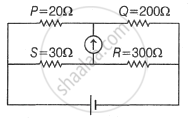
The figure below shows a balanced Wheatstone network. If it is disturbed by changing P to 22Ω, then which of the following steps will bring the bridge again to a balanced state?
Which of the following is NOT a characteristic of a balanced Wheatstone bridge?
What is the main difference between a balanced and an unbalanced Wheatstone bridge in terms of galvanometer deflection?
