Advertisements
Advertisements
प्रश्न
In a meter bridge, the balance point is found to be at 39.5 cm from the end A when the resistor R is 12.5 Ω (right gap).
a) Determine the resistance of X (left gap).
b) Determine the balance point of the bridge if X and R are interchanged?
c) What happens if the galvanometer and cell are interchanged at the balance point of the bridge?
Advertisements
उत्तर
Given:
lX = 39.5 cm, R = 12.5 Ω,
lR = (100 - lX) = 100 - 39.5 = 60.5 cm.
- Since, the bridge is balanced,
`"X"/"R" = "l"_"x"/"l"_"R"`
∴ X = `"l"_"x"/"l"_"R" xx "R"`
= `39.5/60.5 xx 12.5 = 8.16` Ω - When X and R are interchanged then their respective lengths also get interchange.
∴ The new balance point will be at 60.5 cm - If the galvanometer and the cell are interchanged then the balance point remains unchanged.
APPEARS IN
संबंधित प्रश्न
With the help of a labelled diagram, show that the balancing condition of a Wheatstone bridge is
`R_1/R_2 = R_3/R_4` where the terms have their usual meaning.
Four resistances 4 Ω, 8Ω, XΩ and 12Ω are connected in a series to form Wheatstone’s network. If the network is balanced, the value of X is ______.
In a meter bridge, two unknown resistances R and S, when connected between the two gaps, give a null point is 60 cm from one end. What is the ratio of R and S?
In a Wheatstone bridge, when the potentials at points B and D are the same, then the current through the galvanometer ______

With a resistance of 'X' in the left gap and a resistance of 9 Ω in the right gap of a meter bridge, the balance point is obtained at 40 cm from the left end.
In what way and to which resistance 3 Ω resistance be connected to obtain the balance at 50 cm from the left end?
On interchanging the resistances, the balance point of a metre bridge shifts to the left by 10 cm. The resistance of their series combination is 1 k`Omega`. How much was the resistance on the left slot before interchanging the resistances?
In Wheatstone's network p = 2 `Omega` , Q = 2 `Omega`, R = 2 `Omega` and S = 3 `Omega`. The resistance with which S is to be shunted in order that the bridge may be balanced is ______.
In the network shown cell E has internal resistance r and the galvanometer shows zero deflection. If the cell is replaced by a new cell of emf 2E and internal resistance 3r keeping everything else identical, then ______.

In following figure, a current of 1.4 A flows towards the bridge circuit. The current in 2 n resistor is ______.
The potential difference between the points A and B in the electric circuit shown is ______.

Which among the following resistances can be determined by a metre bridge?
In a meter bridge experiment, to minimize an error due to contact resistance, ______
ln, a Wheatstone network, P = Q = R = 8 `Omega` and S is 10 `Omega`. The required resistance to be connected to S so that network is balanced is ______.
The resistances in left and right gap of a meter-bridge are 3 `Omega` and 5 `Omega` respectively. When the resistance in the left gap is increased by 10%, the balance point shifts nearly by ______.
Draw a neat labelled diagram to determine unknown resistance using a meter bridge.
Draw a neat labelled diagram of Kelvin's meter bridge circuit for the measurement of galvanometer resistance.
What is a post office box? How is the· unknown resistance measured using a post office box?
In the given Wheatstone's network, what should be the value of R for the network to be balanced?
Write balancing condition of a Wheatstone bridge.
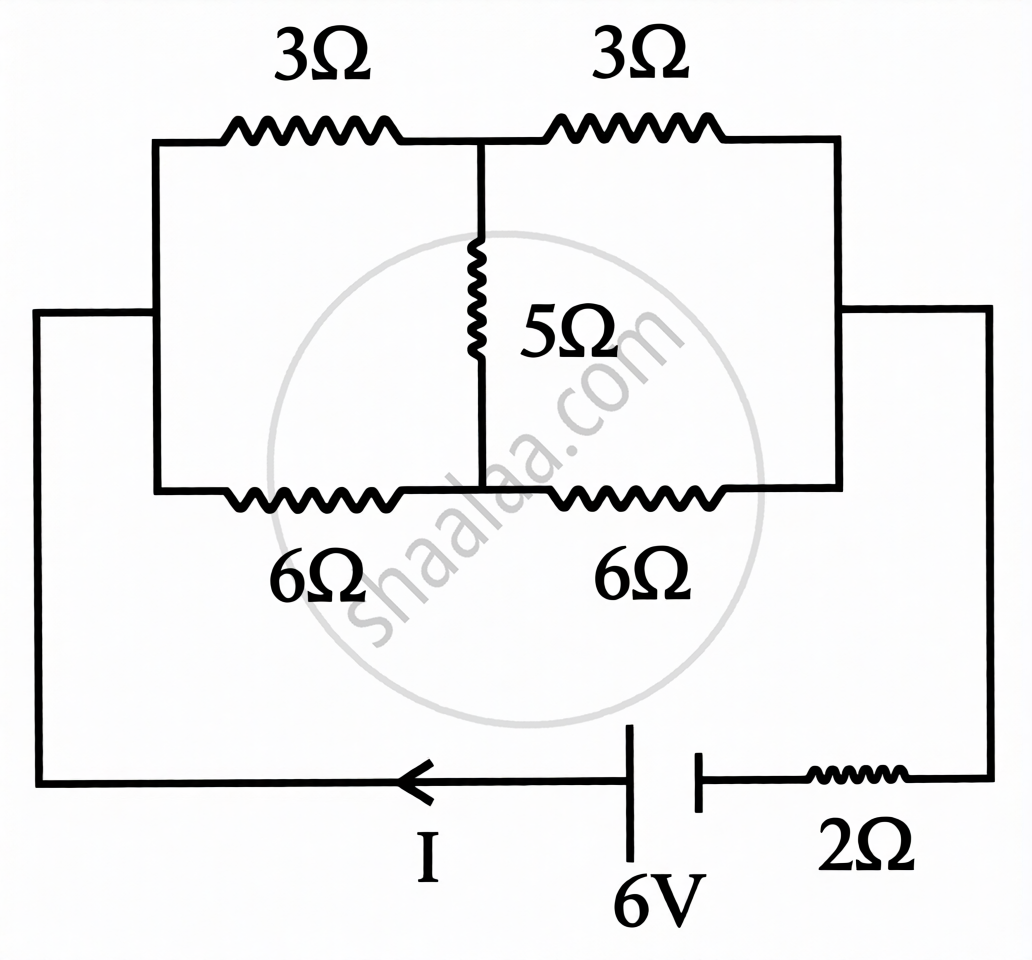
A battery of 6 V is connected to the circuit as shown below. The current I drawn from the battery is:
What is the condition called when the galvanometer shows zero deflection in a Wheatstone bridge, with \[I_g = 0\]?
What is the mathematical expression for the balance condition of a Wheatstone bridge?
Which diagonal in a Wheatstone bridge serves as the galvanometer arm?
What is the significance of the null deflection condition in a Wheatstone bridge?
In a Wheatstone bridge, what happens when the galvanometer shows zero deflection?
What is the main difference between a balanced and an unbalanced Wheatstone bridge in terms of galvanometer deflection?
Based on the balance condition, if \[R_1 = 100 \Omega\], \[R_2 = 200 \Omega\], and \[R_3 = 50 \Omega\], what must \[R_4\] be for the bridge to be balanced?
