Advertisements
Advertisements
प्रश्न
Four resistances 4 Ω, 8Ω, XΩ and 12Ω are connected in a series to form Wheatstone’s network. If the network is balanced, the value of X is ______.
विकल्प
24
18
12
8
6
Advertisements
उत्तर
Four resistances 4 Ω, 8Ω, XΩ, and 12Ω are connected in a series to form Wheatstone’s network. If the network is balanced, the value of X is 6.
Notes
संबंधित प्रश्न
Obtain the balancing condition for the Wheatstone bridge arrangements as shown in Figure 4 below:
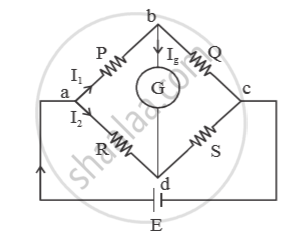
In a meter bridge, two unknown resistances R and S, when connected between the two gaps, give a null point is 60 cm from one end. What is the ratio of R and S?
In conversion of moving coil galvanometer into an ammeter of required range, the resistance of ammeter, so formed is ______.
[S = shunt and G = resistance of galvanometer]
In a metre bridge, the gaps are closed by two resistances P and Q and the balance point is obtained at 40 cm. When Q is shunted by a resistance of 10 Ω, the balance point shifts to 50 cm. The values of P and Q are ______
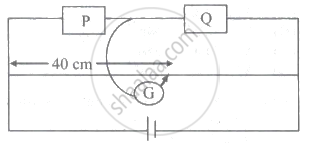
In a metre bridge experiment. the ratio of the left-gap resistance to right gap resistance is 2: 3. The balance point from the left is ______.
In Wheatstone's bridge P = 7 ohm, Q = 12 ohm, R = 3 ohm and S = 8 ohm. How much resistance must be put in parallel to the resistance S to balance the bridge?
The resistances in left and right gap of a metrebridge are 20 `Omega` and 30 `Omega` respectively. When the resistance in the left gap is reduced to half its value, the balance point shifts by ______.
In the Wheatstone bridge, (shown in the figure) X = Y and A > B. The direction of the current between a and b will be ____________.

In the network shown cell E has internal resistance r and the galvanometer shows zero deflection. If the cell is replaced by a new cell of emf 2E and internal resistance 3r keeping everything else identical, then ______.

In a balanced metre bridge, 5 Ω is connected in the left gap and R Ω in the right gap. When R Ω is shunted with equal resistance, the new balance point is at 1.6 I1 where 'I1' is the earlier balancing length. The value of 'I1' is ______
The current through 1 `Omega` resistance in the following circuit is ______.

A resistance R is to be measured using a meter bridge. Student chooses the standard resistance S to be 100Ω. He finds the null point at l1 = 2.9 cm. He is told to attempt to improve the accuracy. Which of the following is a useful way?
The measurement of an unknown resistance R is to be carried out using Wheatstones bridge (figure). Two students perform an experiment in two ways. The first students takes R2 = 10 Ω and R1 = 5 Ω. The other student takes R2 = 1000 Ω and R1 = 500 Ω. In the standard arm, both take R3 = 5 Ω. Both find R = `R_2/R_1 R_3` = 10 Ω within errors.
- The errors of measurement of the two students are the same.
- Errors of measurement do depend on the accuracy with which R2 and R1 can be measured.
- If the student uses large values of R2 and R1, the currents through the arms will be feeble. This will make determination of null point accurately more difficult.
- Wheatstone bridge is a very accurate instrument and has no errors of measurement.
In the given Wheatstone's network, what should be the value of R for the network to be balanced?
A battery of 6 V is connected to the circuit as shown below. The current I drawn from the battery is:
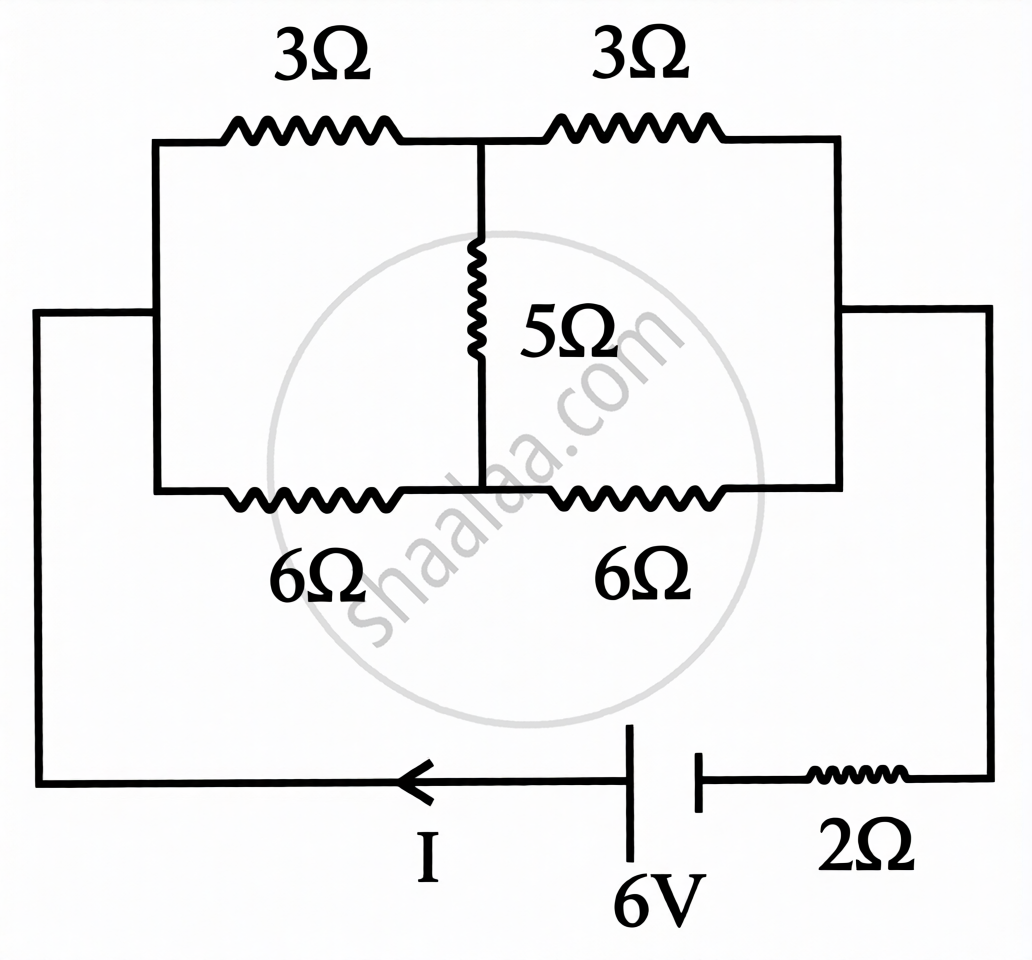
What is the mathematical expression for the balance condition of a Wheatstone bridge?
Which diagonal in a Wheatstone bridge serves as the galvanometer arm?
What is the significance of the null deflection condition in a Wheatstone bridge?
Which of the following is NOT a characteristic of a balanced Wheatstone bridge?
What is the main difference between a balanced and an unbalanced Wheatstone bridge in terms of galvanometer deflection?
In an unbalanced Wheatstone bridge, which approach must be used to find the galvanometer current?
What does 'null deflection' mean in the context of a Wheatstone bridge?
What is the main usefulness of a balanced Wheatstone bridge?
What does an unbalanced Wheatstone bridge indicate in a network?
What is the balance condition used to find the variable resistor Q?
