Advertisements
Advertisements
प्रश्न
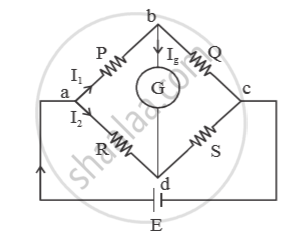
Obtain the balancing condition for the Wheatstone bridge arrangements as shown in Figure 4 below:
Advertisements
उत्तर
Let `I_3` and `I_4` be the currents in resistors Q and S respectively . Let `I_g` be the current through galvanometer. For balanced condition,
`I_g = 0`
Applying junction law at ‘b’ we get
`I_1 = I_3 + I_g`
`because I_g = 0 , I_1 = I_3` ....(i)
Applying junction law at ‘d’, we get
`I_2 + I_g = I_4`
`because I_g = 0 , I_2 = I_4` ....(ii)
Applying loop law in the loop abda, we get
`-I_1·P - I_g·Q + -I_2·R = 0`
⇒ `-I_1P + I_2R = 0` (`because I_g = 0`)
⇒ `I_1P = I_2R`
⇒ `P/R = I_2/I_1` ....(iii)
Applying loop law in the loop bcdb, we get
`-I_3·Q + I_4·S + I_g·6 = 0`
⇒ `-I_3·Q + I_4·S + 0 = 0 (because I_g =0)`
⇒ `-I_3Q = I_4S`
⇒ `Q/S = I_4/I_3`
⇒ `Q/S = I_2/I_1` ...(iv) [using eq.(i) and (ii)]
From eq. (iii) and (iv), `P/ R = Q/s`
⇒ `P/Q = R/S`
This is the balanced condition.
APPEARS IN
संबंधित प्रश्न
The current which flows in a galvanometer of Wheatstone bridge is directly proportional to ______
In a meter bridge experiment, to minimize an error due to contact resistance, ______
ln, a Wheatstone network, P = Q = R = 8 `Omega` and S is 10 `Omega`. The required resistance to be connected to S so that network is balanced is ______.
The measurement of an unknown resistance R is to be carried out using Wheatstones bridge (figure). Two students perform an experiment in two ways. The first students takes R2 = 10 Ω and R1 = 5 Ω. The other student takes R2 = 1000 Ω and R1 = 500 Ω. In the standard arm, both take R3 = 5 Ω. Both find R = `R_2/R_1 R_3` = 10 Ω within errors.
- The errors of measurement of the two students are the same.
- Errors of measurement do depend on the accuracy with which R2 and R1 can be measured.
- If the student uses large values of R2 and R1, the currents through the arms will be feeble. This will make determination of null point accurately more difficult.
- Wheatstone bridge is a very accurate instrument and has no errors of measurement.
In the given Wheatstone's network, what should be the value of R for the network to be balanced?
Two resistances are connected in two gaps of a meter bridge. The null point is obtained at 20 cm from zero end. A resistance of 15 is connected in series with smaller of the two. The null point shifts to 40 cm. The smaller resistance used in is ______.
In a Wheatstone’s bridge, three resistances P, Q and R connected in the three arms and the fourth arm is formed by two resistances S1 and S2 connected in parallel. The condition for the bridge to be balanced will be ______.
Which of the following is NOT a characteristic of a balanced Wheatstone bridge?
In an unbalanced Wheatstone bridge, which approach must be used to find the galvanometer current?
Which of the following is a device that operates on the Wheatstone bridge principle?
