Advertisements
Advertisements
प्रश्न
Draw a labelled circuit diagram of a potentiometer to measure the internal resistance ‘r’ of a cell. Write the working formula (derivation is not required).
Advertisements
उत्तर

The internal resistance can be found using the formula
`r = R(l_1/l_2- 1)`
where R is the resistance of the resistance box connected to the cell through key K2 and l1 and l2 are the balancing lengths corresponding to the cases when key K2 is open and is closed respectively .
APPEARS IN
संबंधित प्रश्न
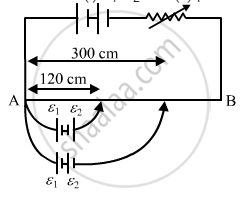
Figure shows a long potentiometer wire AB having a constant potential gradient. The null points for the two primary cells of emfs ε1 and ε2 connected in the manner shown are obtained at a distance of l1 = 120 cm and l2 = 300 cm from the end A. Determine (i) ε1/ε2 and (ii) position of null point for the cell ε1 only.
When a resistor of 5Ω is connected across the cell, its terminal potential difference is balanced by 150 cm of potentiometer wire and when a resistance of 10 Ω is connected across the cell, the terminal potential difference is balanced by 175 cm same potentiometer wire. Find the balancing length when the cell is in open circuit and the internal resistance of the cell.
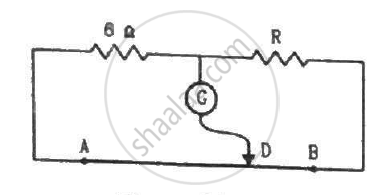
The potentiometer wire AB shown in the figure is 50 cm long. When AD = 30 cm, no deflection occurs in the galvanometer. Find R.
A potentiometer wire has length L For given cell of emf E, the balancing length is `"L"/3` from 3 the positive end of the wire. If the length of the potentiometer wire is increased by 50%, then for the same cell, the balance point is obtained at length.
The length of a potentiometer wire is L. A cell of e.m.f E is balanced at length L/3 from the positive end of the wire. If the length of wire increases by L/2, then the same cell will give balance point at length ____________.
To determine the internal resistance of a cell by using potentiometer, the null point is at 1 m when cell is shunted by 3 Ω resistance and at a length 1.5 m when cell is shunted by 6 Ω resistance. The internal resistance of the cell is ______.
The length of a wire of a potentiometer is 100 cm, and the e.m.f of its standard cell is E volt. It is employed to measure the e.m.f of a battery whose internal resistance is 0.5 `Omega` If the balance point is obtained at `l`= 30 cm from the positive end, the e.m.f of the battery is ____________.
where 'i' is the current in the potentiometer
Specific resistance of a conductor increase with.
The Figure below shows a potentiometer circuit in which the driver cell D has an emf of 6 V and internal resistance of 2 Ω. The potentiometer wire AB is 10 m long and has a resistance of 28 Ω. The series resistance RS is of 2 Ω.

- The current Ip flowing in the potentiometer wire AB when the jockey (J) does not touch the wire AB.
- emf of the cell X if the balancing length AC is 4.5 m.
