Advertisements
Advertisements
प्रश्न
Draw a labelled circuit diagram of a potentiometer to measure the internal resistance ‘r’ of a cell. Write the working formula (derivation is not required).
Advertisements
उत्तर

The internal resistance can be found using the formula
`r = R(l_1/l_2- 1)`
where R is the resistance of the resistance box connected to the cell through key K2 and l1 and l2 are the balancing lengths corresponding to the cases when key K2 is open and is closed respectively .
APPEARS IN
संबंधित प्रश्न
In the given circuit, with steady current, calculate the potential drop across the capacitor and the charge stored in it.

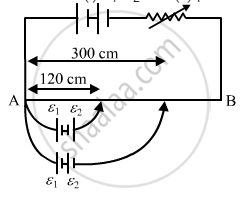
Figure shows a long potentiometer wire AB having a constant potential gradient. The null points for the two primary cells of emfs ε1 and ε2 connected in the manner shown are obtained at a distance of l1 = 120 cm and l2 = 300 cm from the end A. Determine (i) ε1/ε2 and (ii) position of null point for the cell ε1 only.
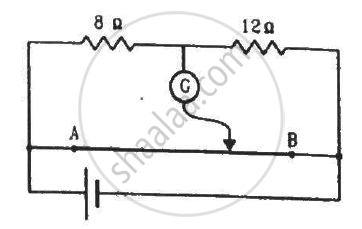
The potentiometer wire AB shown in the figure is 40 cm long. Where should the free end of the galvanometer be connected on AB, so that the galvanometer may show zero deflection?
Draw a labelled circuit diagram of a potentiometer to compare emfs of two cells. Write the working formula (Derivation not required).
Why should not the jockey be slided along the potentiometer wire?
A cell of e.m.f 1.5V and negligible internal resistance is connected in series with a potential meter of length 10 m and the total resistance of 20 Ω. What resistance should be introduced in the resistance box such that the potential drop across the potentiometer is one microvolt per cm of the wire?
In the potentiometer experiment, the balancing length with cell E1 of unknown e.m.f. is ℓ1 cm. By shunting the cell E1 with resistance 'R' which is equal to internal resistance (r) of the cell E1, the balancing length ℓ2 is ______
Potentiometer measures the potential difference more accurately than a voltmeter, because ______.
If you are provided a set of resistances 2Ω, 4Ω, 6Ω and 8Ω. Connect these resistances so as to obtain an equivalent resistance of `46/3`Ω.
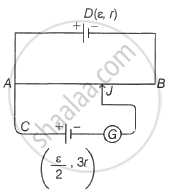
A potentiometer wire AB having length L and resistance 12r is joined to a cell D of emf ε and internal resistance r. A cell C having emt `ε/2` and internal resistance 3r is connected. The length AJ at which the galvanometer as shown in the figure shows no deflection is ______.