Advertisements
Advertisements
प्रश्न
The Figure below shows a potentiometer circuit in which the driver cell D has an emf of 6 V and internal resistance of 2 Ω. The potentiometer wire AB is 10 m long and has a resistance of 28 Ω. The series resistance RS is of 2 Ω.

- The current Ip flowing in the potentiometer wire AB when the jockey (J) does not touch the wire AB.
- emf of the cell X if the balancing length AC is 4.5 m.
Advertisements
उत्तर
- Resistance of 10 m wire AB = 28 Ω
Rs = 20 Ω
r = 2 Ω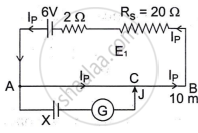
∴ Total resistance (R) = (28 + 20 + 2) Ω = 50 Ω
`I_p = V/R`
= `6/50 A`
= 0.12 A - VAB = IP × RAB
= 0.12 × 28 V
= 3.36 V
emf of cell `X = Kl ...(("Here" K = 3.36/10 Vm^-1 = 0.336 Vm^-1),(and l = 4.5 m))`
X = 0.336 × 4.5 V
X = 1.512 V
APPEARS IN
संबंधित प्रश्न
SI unit of potential gradient is _______.
(a) V cm
(b) `V/"cm"`
(c) Vm
(d) `V/m`
Write the principle of working of a potentiometer. Describe briefly, with the help of a circuit diagram, how a potentiometer is used to determine the internal resistance of a given cell.
Draw a labelled circuit diagram of a potentiometer to compare emfs of two cells. Write the working formula (Derivation not required).
Why is a potentiometer preferred over a voltmeter for measuring emf?
The resistance of a potentiometer wire is 8 Ω and its length is 8 m. A resistance box and a 2 V battery are connected in series with iL What should be the resistance in the box if it is desired to have a potential drop of 1 µV/mm?
When two cells of e.m.f 1.5 V and 1.1 V connected in series are balanced on a potentiometer, the balancing length is 260 cm. The balancing length, when they are connected in opposition is (in cm) ____________.
A potentiometer is used to measure the potential difference between A and B, the null point is obtained at 0.9 m. Now the potential difference between A and C is measured, the null point is obtained at 0.3 m. The ratio `E_2/E_1` is (E1 > E2) ______

In the potentiometer experiment, cells of e.m.f. E1 and E2 are connected in series (E1 > E2). the balancing length is 64 cm of the wire. If the polarity of E2 is reversed, the balancing length becomes 32 cm. The ratio `E_1/E_2` is ______
In a potentiometer experiment, for measuring internal resistance of a cell, the balance point has been obtained on the fourth wire. The balance point can be shifted to fifth wire by ______.
It is observed in a potentiometer experiment that no current passes through the galvanometer when the terminals of the cell are connected across a certain length of the potentiometer wire. On shunting the cell by a 2 Ω resistance, the balancing length is reduced to half. The internal resistance of the cell is ______.
