Advertisements
Advertisements
प्रश्न
Write balancing condition of a Wheatstone bridge.
Advertisements
उत्तर
When no current flows through the galvanometer, the wheatstone bridge is considered to be in a balanced state. This condition can be met by modifying the known and variable resistance.
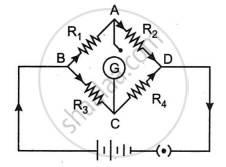
The balancing condition,
`"R"_1/"R"_2 = "R"_3/"R"_4`
APPEARS IN
संबंधित प्रश्न
Four resistances 6Ω, 6Ω, 6Ω and 18Ω form a Wheatstone bridge. Find the resistance which connected across the 18Ω resistance will balance the network.
The current which flows in a galvanometer of Wheatstone bridge is directly proportional to ______
In a metre bridge, the gaps are closed by two resistances P and Q and the balance point is obtained at 40 cm. When Q is shunted by a resistance of 10 Ω, the balance point shifts to 50 cm. The values of P and Q are ______
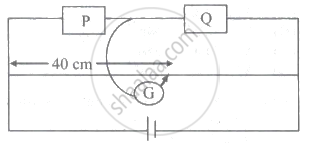
What is the e.m.f of the cell C in the circuit shown in figure, if the deflection in the galvanometer is zero, the resistance of the wire is 3 `Omega`, The length of the wire is 100 cm?

A resistance of 5 `Omega` is connected in the left gap of a metre bridge and 15 `Omega` in the other gap. The position of the balancing point is ____________.
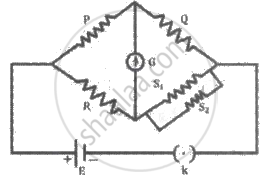
In a Wheatstone's bridge, the resistance in the three arms are P, Q, R, and its fourth arm has a parallel combination of two resistances S1 and S2, The balancing condition of the bridge is ______
Which of the following is NOT a characteristic of a balanced Wheatstone bridge?
What does an unbalanced Wheatstone bridge indicate in a network?
Why is high accuracy achievable in Wheatstone bridge measurements?
