Advertisements
Advertisements
Question
Write balancing condition of a Wheatstone bridge.
Advertisements
Solution
When no current flows through the galvanometer, the wheatstone bridge is considered to be in a balanced state. This condition can be met by modifying the known and variable resistance.
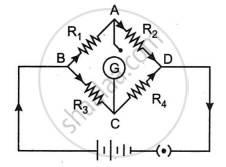
The balancing condition,
`"R"_1/"R"_2 = "R"_3/"R"_4`
APPEARS IN
RELATED QUESTIONS
State any two sources of errors in the meter-bridge experiment. Explain how they can be minimized.
In a metre bridge, the gaps are closed by two resistances P and Q and the balance point is obtained at 40 cm. When Q is shunted by a resistance of 10 Ω, the balance point shifts to 50 cm. The values of P and Q are ______
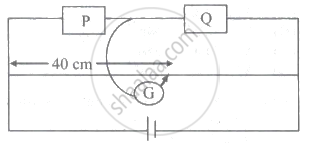
With a resistance of 'X' in the left gap and a resistance of 9 Ω in the right gap of a meter bridge, the balance point is obtained at 40 cm from the left end.
In what way and to which resistance 3 Ω resistance be connected to obtain the balance at 50 cm from the left end?
On interchanging the resistances, the balance point of a metre bridge shifts to the left by 10 cm. The resistance of their series combination is 1 k`Omega`. How much was the resistance on the left slot before interchanging the resistances?
In Wheatstone's network p = 2 `Omega` , Q = 2 `Omega`, R = 2 `Omega` and S = 3 `Omega`. The resistance with which S is to be shunted in order that the bridge may be balanced is ______.
ln the metre bridge experiment, one metre long wire acts as ____________.
What is the primary purpose of a Wheatstone bridge in electrical circuits?
Which of the following is NOT a characteristic of a balanced Wheatstone bridge?
Why is high accuracy achievable in Wheatstone bridge measurements?
