Advertisements
Advertisements
Question
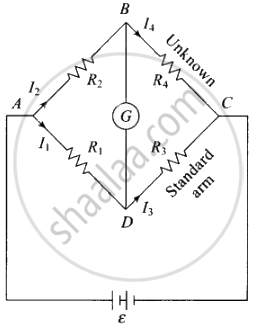
The measurement of an unknown resistance R is to be carried out using Wheatstones bridge (figure). Two students perform an experiment in two ways. The first students takes R2 = 10 Ω and R1 = 5 Ω. The other student takes R2 = 1000 Ω and R1 = 500 Ω. In the standard arm, both take R3 = 5 Ω. Both find R = `R_2/R_1 R_3` = 10 Ω within errors.
- The errors of measurement of the two students are the same.
- Errors of measurement do depend on the accuracy with which R2 and R1 can be measured.
- If the student uses large values of R2 and R1, the currents through the arms will be feeble. This will make determination of null point accurately more difficult.
- Wheatstone bridge is a very accurate instrument and has no errors of measurement.
Options
a and b
b and c
c and d
a and d
Advertisements
Solution
b and c
Explanation:
Wheatstone bridge: The bridge is an arrangement of four resistance which can be used to measure one of them in terms of rest. Here arms AB and BC are called ratio arm and arms AC and BD are called conjugate arms.
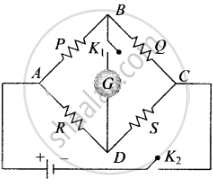
Balanced bridge: The bridge is said to be balanced when deflection in the galvanometer is zero, i.e. no current flows through the galvanometer or in other words VB = VD. In the balanced condition `P/Q = R/S`, on mutually changing the position of cell and galvanometer this condition will not change.
Unbalanced bridge: If the bridge is not balanced current will flow from D to B if VD > VB, i.e. (VA – VD) < (VA – VB) which gives PS > RQ.
According to the problem for first students, R2 = 10 Ω, R1 = 5 Ω, R3 = 5 Ω
For second student, R1 = 500 Ω, R2 = 1000 Ω, R3 = 5 Ω
Let us take R4 = R.
Now, according to the Wheatstone bridge rule,
`R_2/R_1 = R_4/R_3` ⇒ `R_4 = R_3 xx R_2/R_1`
Now putting all the values in above equation, we get R = 10 Ω for both students. Thus, we can analyse that the Wheatstone bridge is most sensitive and accurate if resistances are of the same value.
Thus, the errors of measurement of the two students depend on the accuracy and sensitivity of the bridge, which in turn depends on the accuracy with which R2 and R1 can be measured.
The currents through the arms of bridge is very weak when R2 and R1 are larger.
This can make the determination of null point accurately more difficult.
APPEARS IN
RELATED QUESTIONS
With the help of a labelled diagram, show that the balancing condition of a Wheatstone bridge is
`R_1/R_2 = R_3/R_4` where the terms have their usual meaning.
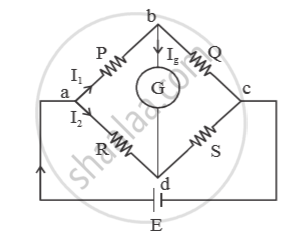
Obtain the balancing condition for the Wheatstone bridge arrangements as shown in Figure 4 below:
In a meter bridge, two unknown resistances R and S, when connected between the two gaps, give a null point is 60 cm from one end. What is the ratio of R and S?
The metre bridge works on the principle of ______.
In Wheatstone's bridge P = 7 ohm, Q = 12 ohm, R = 3 ohm and S = 8 ohm. How much resistance must be put in parallel to the resistance S to balance the bridge?
In following figure, a current of 1.4 A flows towards the bridge circuit. The current in 2 n resistor is ______.
In the meter bridge experiment, the null point is obtained at a distance of ℓ from the left end. The resistance in the left and right gaps are halved and then interchanged. The new position of the null point is at ______
In a balanced metre bridge, 5 Ω is connected in the left gap and R Ω in the right gap. When R Ω is shunted with equal resistance, the new balance point is at 1.6 I1 where 'I1' is the earlier balancing length. The value of 'I1' is ______
When an unknown resistance 'X' is connected in the left gap of a meter bridge and a known resistance 'R' in the right gap, a null point is obtained at 40 cm from the left end. If a 2 Ω resistance is connected in series with 'X' the null point shifts towards the right by 10 cm, with some resistance in the right gap. The value of 'X' must be ______
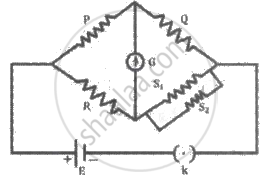
In a Wheatstone's bridge, the resistance in the three arms are P, Q, R, and its fourth arm has a parallel combination of two resistances S1 and S2, The balancing condition of the bridge is ______
A resistance R is to be measured using a meter bridge. Student chooses the standard resistance S to be 100Ω. He finds the null point at l1 = 2.9 cm. He is told to attempt to improve the accuracy. Which of the following is a useful way?
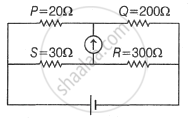
The figure below shows a balanced Wheatstone network. If it is disturbed by changing P to 22Ω, then which of the following steps will bring the bridge again to a balanced state?
Find the radius of the wire of length 25m needed to prepare a coil of resistance 25Ω. (Resistivity of material of wire is 3.142 x 10⁻⁷Ωm)
Write balancing condition of a Wheatstone bridge.
What is the mathematical expression for the balance condition of a Wheatstone bridge?
What is the main difference between a balanced and an unbalanced Wheatstone bridge in terms of galvanometer deflection?
What would happen if the galvanometer in a Wheatstone bridge were replaced with a voltmeter?
