Advertisements
Advertisements
प्रश्न
In a meter bridge, the balance point is found to be at 39.5 cm from the end A when the resistor R is 12.5 Ω (right gap).
a) Determine the resistance of X (left gap).
b) Determine the balance point of the bridge if X and R are interchanged?
c) What happens if the galvanometer and cell are interchanged at the balance point of the bridge?
Advertisements
उत्तर
Given:
lX = 39.5 cm, R = 12.5 Ω,
lR = (100 - lX) = 100 - 39.5 = 60.5 cm.
- Since, the bridge is balanced,
`"X"/"R" = "l"_"x"/"l"_"R"`
∴ X = `"l"_"x"/"l"_"R" xx "R"`
= `39.5/60.5 xx 12.5 = 8.16` Ω - When X and R are interchanged then their respective lengths also get interchange.
∴ The new balance point will be at 60.5 cm - If the galvanometer and the cell are interchanged then the balance point remains unchanged.
APPEARS IN
संबंधित प्रश्न
Choose the correct:
Four resistances 10 Ω, 10 Ω, 10 Ω and 15 Ω form a Wheatstone’s network. What shunt is required across 15 Ω resistor to balance the bridge
In a Wheatstone bridge, when the potentials at points B and D are the same, then the current through the galvanometer ______

In a metre bridge experiment, the null point is obtained at 20 cm from one end of the wire when resistance X is balanced against another resistance Y. If X < Y, then where will be the new position of the null point from the same end, if one decides to balance a resistance of 4X against Y?
In a metre bridge, the gaps are closed by two resistances P and Q and the balance point is obtained at 40 cm. When Q is shunted by a resistance of 10 Ω, the balance point shifts to 50 cm. The values of P and Q are ______
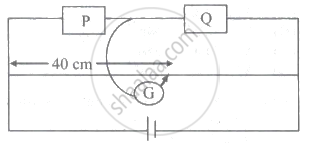
In a metre bridge experiment. the ratio of the left-gap resistance to right gap resistance is 2: 3. The balance point from the left is ______.
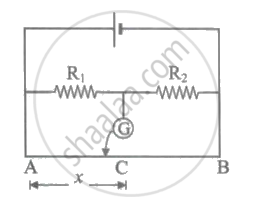
In the metre bridge experiment shown in the figure, the balance length AC corresponding to null deflection of the galvanometer is x. What would be the balance length if the radius of the wire AB is doubled?
On interchanging the resistances, the balance point of a metre bridge shifts to the left by 10 cm. The resistance of their series combination is 1 k`Omega`. How much was the resistance on the left slot before interchanging the resistances?
In the Wheatstone bridge, (shown in the figure) X = Y and A > B. The direction of the current between a and b will be ____________.

When the value of R in the balanced Wheatstone bridge, shown in the figure, is increased from 5 `Omega` to 7 `Omega`, the value of s has to be increased by 3 `Omega` in order to maintain the balance. What is the initial value of S?
A resistance of 5 `Omega` is connected in the left gap of a metre bridge and 15 `Omega` in the other gap. The position of the balancing point is ____________.
In following figure, a current of 1.4 A flows towards the bridge circuit. The current in 2 n resistor is ______.
In a meter bridge experiment, to minimize an error due to contact resistance, ______
In a metre bridge experiment, the ratio of the left-gap resistance to right gap resistance is 2: 3. The balance point from the left is ______.
ln, a Wheatstone network, P = Q = R = 8 `Omega` and S is 10 `Omega`. The required resistance to be connected to S so that network is balanced is ______.
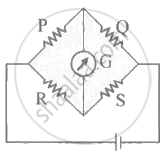
The figure below shows a balanced Wheatstone network. If it is disturbed by changing P to 22Ω, then which of the following steps will bring the bridge again to a balanced state?
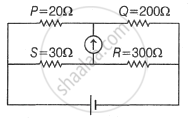
- Assertion (A): The given figure does not show a balanced Wheatstone bridge.
- Reason (R): For a balanced bridge small current should flow through the galvanometer.
Find the radius of the wire of length 25m needed to prepare a coil of resistance 25Ω. (Resistivity of material of wire is 3.142 x 10⁻⁷Ωm)
Four resistances 4Ω, 4Ω, 4Ω and 12Ω form a Wheatstone's network. Find the resistance which when connected across the 12Ω resistance will balance the network.
In the given Wheatstone's network, what should be the value of R for the network to be balanced?
Write balancing condition of a Wheatstone bridge.
In a Wheatstone’s bridge, three resistances P, Q and R connected in the three arms and the fourth arm is formed by two resistances S1 and S2 connected in parallel. The condition for the bridge to be balanced will be ______.
What is the mathematical expression for the balance condition of a Wheatstone bridge?
What is the main difference between a balanced and an unbalanced Wheatstone bridge in terms of galvanometer deflection?
What does 'null deflection' mean in the context of a Wheatstone bridge?
What is the role of the battery arm in a Wheatstone bridge circuit?
What is the main usefulness of a balanced Wheatstone bridge?
Why is high accuracy achievable in Wheatstone bridge measurements?
In a Wheatstone bridge with \[R_1 = 200 \Omega\], \[R_2 = 300 \Omega\], and \[R_3 = 120 \Omega\], what is the value of the unknown resistance \[R_4\]?
