Advertisements
Advertisements
प्रश्न
- Assertion (A): The given figure does not show a balanced Wheatstone bridge.
- Reason (R): For a balanced bridge small current should flow through the galvanometer.
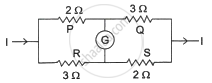
पर्याय
Both Assertion (A) and Reason (R) are true and (R) is the correct explanation of (A).
Both Assertion (A) and Reason (R) are true and (R) is NOT the correct explanation of (A).
Assertion (A) is true and Reason (R) is false.
Assertion (A) is false and Reason (R) is also false.
Advertisements
उत्तर
Assertion (A) is true and Reason (R) is false.
Explanation:
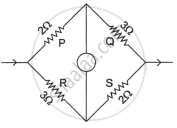
For a balanced Wheatstone Bridge,
`P/Q = R/S`
⇒ `2/3 = 3/2`
0.67 = 1.5
`P/Q ≠ R/S`
As a result, it isn't a balanced Wheatstone bridge. The current through a galvanometer must be zero in the case of a balanced Wheatstone bridge. As a result, the reason is incorrect and the statement is correct.
APPEARS IN
संबंधित प्रश्न
State any two sources of errors in the meter-bridge experiment. Explain how they can be minimized.
In a metre bridge experiment, the null point is obtained at 20 cm from one end of the wire when resistance X is balanced against another resistance Y. If X < Y, then where will be the new position of the null point from the same end, if one decides to balance a resistance of 4X against Y?
In a metre bridge, the gaps are closed by two resistances P and Q and the balance point is obtained at 40 cm. When Q is shunted by a resistance of 10 Ω, the balance point shifts to 50 cm. The values of P and Q are ______
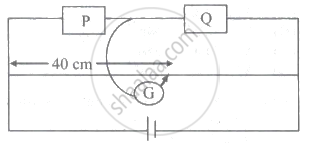
The metre bridge works on the principle of ______.
In the Wheatstone bridge, (shown in the figure) X = Y and A > B. The direction of the current between a and b will be ____________.

In the meter bridge experiment, a null point was obtained at a distance of ℓ from the left end. The values of resistances in the left and right gaps are doubled and then interchanged. The new position of a null point is ______
A resistance of 20 Ω is connected in the left gap of a meter bridge and an unknown resistance greater than 20 Ω is connected in the right gap. When these resistances are interchanged, the balance point shifts by 20 cm. The unknown resistance is ______.
With an unknown resistance X in the left gap and a resistance of 30 Ω of the gap of a metre bridge, the null point is obtained at 40 cm from the left end of the wire. Find the unknown resistance. Also, find the shift in the null point when resistance in each gap is shunted by a resistance of 8 Ω.
Four resistances 4Ω, 4Ω, 4Ω and 12Ω form a Wheatstone's network. Find the resistance which when connected across the 12Ω resistance will balance the network.
