Advertisements
Advertisements
प्रश्न
- Assertion (A): The given figure does not show a balanced Wheatstone bridge.
- Reason (R): For a balanced bridge small current should flow through the galvanometer.
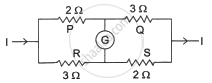
विकल्प
Both Assertion (A) and Reason (R) are true and (R) is the correct explanation of (A).
Both Assertion (A) and Reason (R) are true and (R) is NOT the correct explanation of (A).
Assertion (A) is true and Reason (R) is false.
Assertion (A) is false and Reason (R) is also false.
Advertisements
उत्तर
Assertion (A) is true and Reason (R) is false.
Explanation:
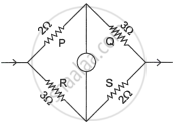
For a balanced Wheatstone Bridge,
`P/Q = R/S`
⇒ `2/3 = 3/2`
0.67 = 1.5
`P/Q ≠ R/S`
As a result, it isn't a balanced Wheatstone bridge. The current through a galvanometer must be zero in the case of a balanced Wheatstone bridge. As a result, the reason is incorrect and the statement is correct.
APPEARS IN
संबंधित प्रश्न
The current which flows in a galvanometer of Wheatstone bridge is directly proportional to ______
In Wheatstone's network p = 2 `Omega` , Q = 2 `Omega`, R = 2 `Omega` and S = 3 `Omega`. The resistance with which S is to be shunted in order that the bridge may be balanced is ______.
ln the metre bridge experiment, one metre long wire acts as ____________.
In the network shown cell E has internal resistance r and the galvanometer shows zero deflection. If the cell is replaced by a new cell of emf 2E and internal resistance 3r keeping everything else identical, then ______.

A resistance of 5 `Omega` is connected in the left gap of a metre bridge and 15 `Omega` in the other gap. The position of the balancing point is ____________.
In the meter bridge experiment, the null point is obtained at a distance of ℓ from the left end. The resistance in the left and right gaps are halved and then interchanged. The new position of the null point is at ______
ln, a Wheatstone network, P = Q = R = 8 `Omega` and S is 10 `Omega`. The required resistance to be connected to S so that network is balanced is ______.
The measurement of an unknown resistance R is to be carried out using Wheatstones bridge (figure). Two students perform an experiment in two ways. The first students takes R2 = 10 Ω and R1 = 5 Ω. The other student takes R2 = 1000 Ω and R1 = 500 Ω. In the standard arm, both take R3 = 5 Ω. Both find R = `R_2/R_1 R_3` = 10 Ω within errors.
- The errors of measurement of the two students are the same.
- Errors of measurement do depend on the accuracy with which R2 and R1 can be measured.
- If the student uses large values of R2 and R1, the currents through the arms will be feeble. This will make determination of null point accurately more difficult.
- Wheatstone bridge is a very accurate instrument and has no errors of measurement.
Which of the following is NOT a characteristic of a balanced Wheatstone bridge?
What is the role of the battery arm in a Wheatstone bridge circuit?
