Advertisements
Advertisements
Question
- Assertion (A): The given figure does not show a balanced Wheatstone bridge.
- Reason (R): For a balanced bridge small current should flow through the galvanometer.
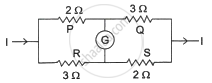
Options
Both Assertion (A) and Reason (R) are true and (R) is the correct explanation of (A).
Both Assertion (A) and Reason (R) are true and (R) is NOT the correct explanation of (A).
Assertion (A) is true and Reason (R) is false.
Assertion (A) is false and Reason (R) is also false.
Advertisements
Solution
Assertion (A) is true and Reason (R) is false.
Explanation:
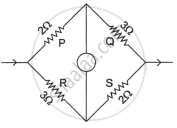
For a balanced Wheatstone Bridge,
`P/Q = R/S`
⇒ `2/3 = 3/2`
0.67 = 1.5
`P/Q ≠ R/S`
As a result, it isn't a balanced Wheatstone bridge. The current through a galvanometer must be zero in the case of a balanced Wheatstone bridge. As a result, the reason is incorrect and the statement is correct.
APPEARS IN
RELATED QUESTIONS
In a Wheatstone bridge, when the potentials at points B and D are the same, then the current through the galvanometer ______

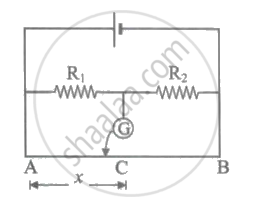
In the metre bridge experiment shown in the figure, the balance length AC corresponding to null deflection of the galvanometer is x. What would be the balance length if the radius of the wire AB is doubled?
On interchanging the resistances, the balance point of a metre bridge shifts to the left by 10 cm. The resistance of their series combination is 1 k`Omega`. How much was the resistance on the left slot before interchanging the resistances?
In Wheatstone's network p = 2 `Omega` , Q = 2 `Omega`, R = 2 `Omega` and S = 3 `Omega`. The resistance with which S is to be shunted in order that the bridge may be balanced is ______.
Two resistances prepared from the wire of the same material having diameters in the ratio 2 : 1 and lengths in the ratio 2 : 1 are connected in the left gap and right gap of Wheatstone's meter bridge respectively. The distance of the null point from the left end of the wire is ______
In a balanced metre bridge, 5 Ω is connected in the left gap and R Ω in the right gap. When R Ω is shunted with equal resistance, the new balance point is at 1.6 I1 where 'I1' is the earlier balancing length. The value of 'I1' is ______
When an unknown resistance 'X' is connected in the left gap of a meter bridge and a known resistance 'R' in the right gap, a null point is obtained at 40 cm from the left end. If a 2 Ω resistance is connected in series with 'X' the null point shifts towards the right by 10 cm, with some resistance in the right gap. The value of 'X' must be ______
In the given Wheatstone's network, what should be the value of R for the network to be balanced?
What is the balance condition used to find the variable resistor Q?
What would happen if the galvanometer in a Wheatstone bridge were replaced with a voltmeter?
