Advertisements
Advertisements
Question
- Assertion (A): The deflecting torque acting on a current-carrying loop is zero when its plane is perpendicular to the direction of the magnetic field.
- Reason (R): The deflecting torque acting on a loop of the magnetic moment `vecm` in a magnetic field `vecB` is given by the dot product of `vecm` and `vecB`.
Options
Both Assertion (A) and Reason (R) are true and (R) is the correct explanation of (A).
Both Assertion (A) and Reason (R) are true and (R) is not the correct explanation of (A).
Assertion (A) is true and Reason (R) is false.
Assertion (A) is false and Reason (R) is also false.
Advertisements
Solution
Assertion (A) is true and Reason (R) is false.
Explanation:
The deflecting torque acting on a current-carrying loop placed in a magnetic field is given by the equation:
`vectau = vecm xx vecB`
Where τ is the deflecting torque, m is the magnetic moment of the loop, and B is the magnetic field. The symbol "x" denotes the vector product.
When the plane of the loop is perpendicular to the direction of the magnetic field, the angle between the magnetic moment vector and the magnetic field vector is 90°.
Both the deflecting torque and the vector product of the two vectors attain their maximum levels in this condition. However, the dot product of the two vectors is zero.
APPEARS IN
RELATED QUESTIONS
A rectangular loop of wire of size 4 cm × 10 cm carries a steady current of 2 A. A straight long wire carrying 5 A current is kept near the loop as shown. If the loop and the wire are coplanar, find
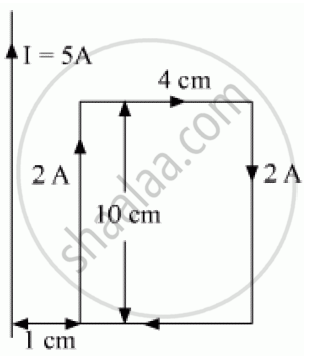
(i) the torque acting on the loop and
(ii) the magnitude and direction of the force on the loop due to the current carrying wire.
Find the magnetic field B at the centre of a rectangular loop of length l and width b, carrying a current i.
A planar loop of rectangular shape is moved within the region of a uniform magnetic field acting perpendicular to its plane. What is the direction and magnitude of the current induced in it?
Consider the motion of a charged particle in a uniform magnetic field directed into the paper. If velocity v of the particle is in the plane of the paper the charged particle will ______.
The rotational effect experienced by a current-carrying loop placed in a uniform magnetic field is called:
The magnetic dipole moment of a coil of N turns, carrying current I and enclosing area A, is:
In a rectangular loop ABCD placed in a uniform magnetic field \[\vec{B}\], the sides AB and CD are parallel to \[\vec{B}\]. The force on each of these sides is:
In a rectangular loop in a uniform magnetic field, the sides BC and AD are perpendicular to \[\vec{B}\]. The magnitude of the force on each of these sides is:
For a rectangular loop whose plane is parallel to \[\vec{B}\] (θ = 90°), the torque is computed as force × perpendicular distance between the two forces, which gives:
The torque acting on a coil of N turns, area A and current I, placed at an angle θ to a uniform magnetic field B, is:
