Advertisements
Advertisements
प्रश्न
Choose the correct:
Four resistances 10 Ω, 10 Ω, 10 Ω and 15 Ω form a Wheatstone’s network. What shunt is required across 15 Ω resistor to balance the bridge
पर्याय
10 Ω
15 Ω
20 Ω
30 Ω
Advertisements
उत्तर
30 Ω
Explanation:
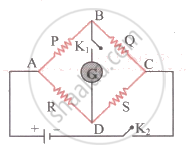
The below diagram represents Wheatstone’s network.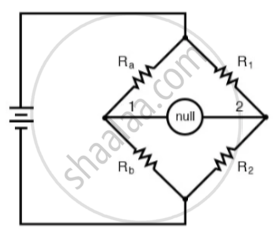
The Wheatstone’s network is said to be balanced when galvanometer shows null deflection. This occurs when:
`R_a/R_b = R_1/R_2`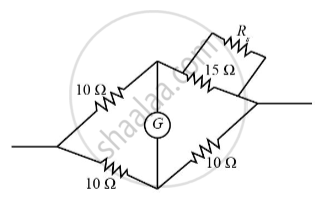
Therefore the given configuration will be balanced when the equivalent resistance, after the shunt resistance Rs being added parallel to the 15 Ω and 10 Ω.
APPEARS IN
संबंधित प्रश्न
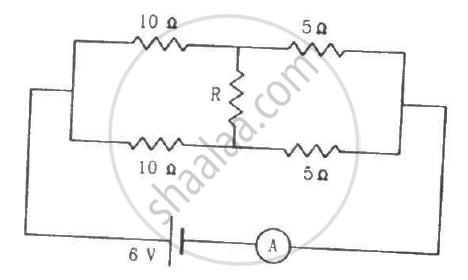
What should be the value of R in the figure for which the current in it is zero?
In Wheatstone’s meter-bridge experiment, the null point is obtained in the middle one-third portion of the wire. Why is it recommended?
In a meter bridge, the balance point is found to be at 39.5 cm from the end A when the resistor R is 12.5 Ω (right gap).
a) Determine the resistance of X (left gap).
b) Determine the balance point of the bridge if X and R are interchanged?
c) What happens if the galvanometer and cell are interchanged at the balance point of the bridge?
On interchanging the resistances, the balance point of a metre bridge shifts to the left by 10 cm. The resistance of their series combination is 1 k`Omega`. How much was the resistance on the left slot before interchanging the resistances?
The resistances in left and right gap of a metrebridge are 20 `Omega` and 30 `Omega` respectively. When the resistance in the left gap is reduced to half its value, the balance point shifts by ______.
In the network shown cell E has internal resistance r and the galvanometer shows zero deflection. If the cell is replaced by a new cell of emf 2E and internal resistance 3r keeping everything else identical, then ______.

A resistance of 5 `Omega` is connected in the left gap of a metre bridge and 15 `Omega` in the other gap. The position of the balancing point is ____________.
The potential difference between the points A and B in the electric circuit shown is ______.

In the meter bridge experiment, a null point was obtained at a distance of ℓ from the left end. The values of resistances in the left and right gaps are doubled and then interchanged. The new position of a null point is ______
In a metre bridge experiment, the ratio of the left-gap resistance to right gap resistance is 2: 3. The balance point from the left is ______.
When an unknown resistance 'X' is connected in the left gap of a meter bridge and a known resistance 'R' in the right gap, a null point is obtained at 40 cm from the left end. If a 2 Ω resistance is connected in series with 'X' the null point shifts towards the right by 10 cm, with some resistance in the right gap. The value of 'X' must be ______
In a Wheatstone's bridge, the resistance in the three arms are P, Q, R, and its fourth arm has a parallel combination of two resistances S1 and S2, The balancing condition of the bridge is ______
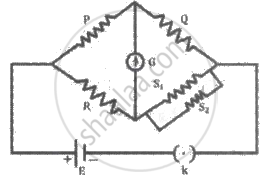
The Wheatstone bridge is in a more balanced state when the ratio of arms P and Q is ______
Draw a neat labelled diagram to determine unknown resistance using a meter bridge.
Draw a neat labelled diagram of Kelvin's meter bridge circuit for the measurement of galvanometer resistance.
In the given Wheatstone's network, what should be the value of R for the network to be balanced?
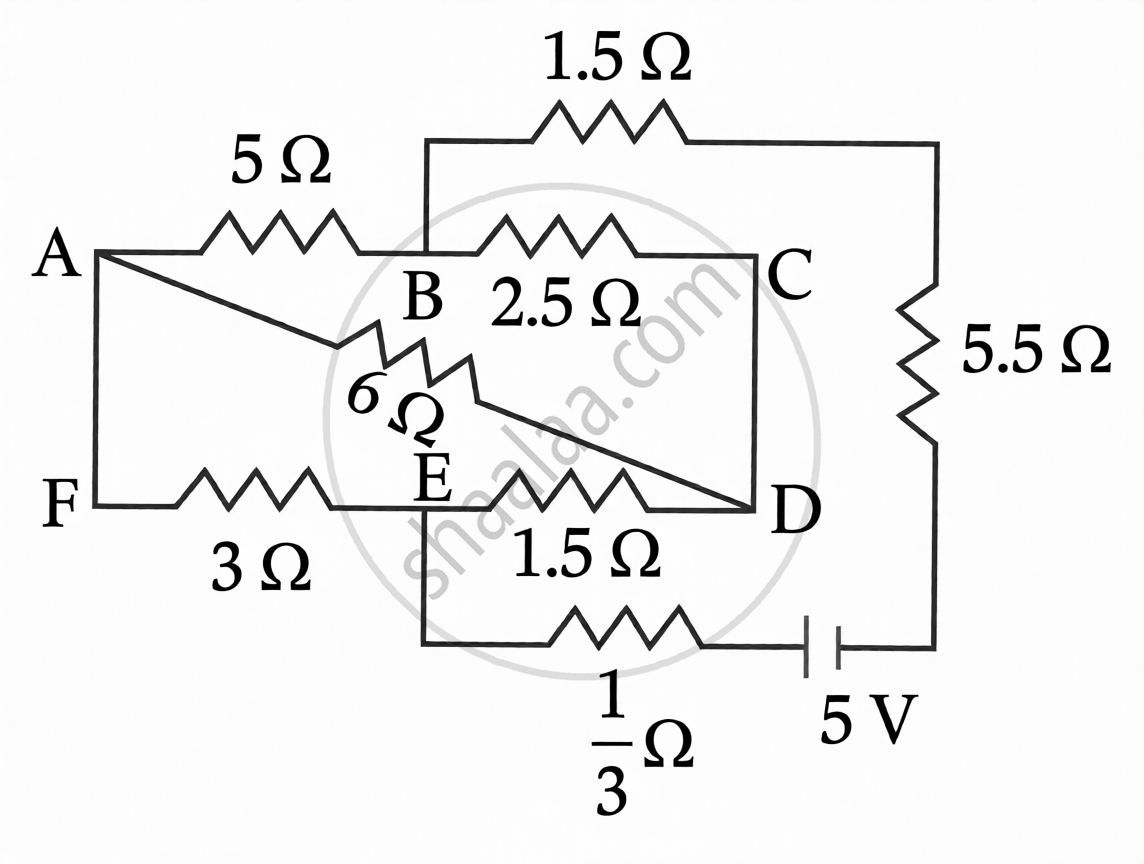
The current passing through the battery in the given circuit is:
In a Wheatstone’s bridge, three resistances P, Q and R connected in the three arms and the fourth arm is formed by two resistances S1 and S2 connected in parallel. The condition for the bridge to be balanced will be ______.
What is the condition called when the galvanometer shows zero deflection in a Wheatstone bridge, with \[I_g = 0\]?
What is the mathematical expression for the balance condition of a Wheatstone bridge?
Which of the following is NOT a characteristic of a balanced Wheatstone bridge?
What does 'null deflection' mean in the context of a Wheatstone bridge?
What is the role of the battery arm in a Wheatstone bridge circuit?
What is the main usefulness of a balanced Wheatstone bridge?
Why is high accuracy achievable in Wheatstone bridge measurements?
What would happen if the galvanometer in a Wheatstone bridge were replaced with a voltmeter?
