Advertisements
Advertisements
प्रश्न
Choose the correct:
Four resistances 10 Ω, 10 Ω, 10 Ω and 15 Ω form a Wheatstone’s network. What shunt is required across 15 Ω resistor to balance the bridge
विकल्प
10 Ω
15 Ω
20 Ω
30 Ω
Advertisements
उत्तर
30 Ω
Explanation:
The below diagram represents Wheatstone’s network.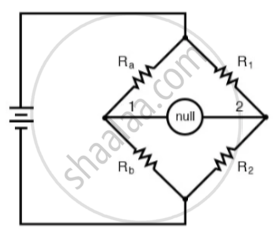
The Wheatstone’s network is said to be balanced when galvanometer shows null deflection. This occurs when:
`R_a/R_b = R_1/R_2`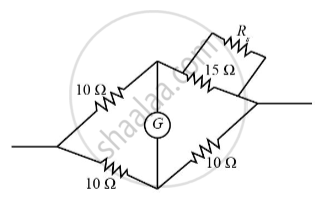
Therefore the given configuration will be balanced when the equivalent resistance, after the shunt resistance Rs being added parallel to the 15 Ω and 10 Ω.
APPEARS IN
संबंधित प्रश्न
Four resistances 6Ω, 6Ω, 6Ω and 18Ω form a Wheatstone bridge. Find the resistance which connected across the 18Ω resistance will balance the network.
The current which flows in a galvanometer of Wheatstone bridge is directly proportional to ______
With resistances P and Q placed in the left and right gaps of a metre bridge, the balance point divides the wire in the ratio of 1/3. When P and Q are increased by 40 n each. the balance point divides the wire in the ratio of 3/5. The values of P and Q will be respectively, ______
In a metre bridge experiment. the ratio of the left-gap resistance to right gap resistance is 2: 3. The balance point from the left is ______.
In the metre bridge experiment shown in the figure, the balance length AC corresponding to null deflection of the galvanometer is x. What would be the balance length if the radius of the wire AB is doubled?
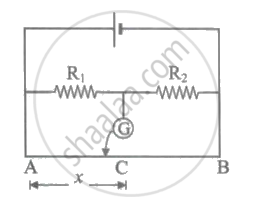
In the network shown cell E has internal resistance r and the galvanometer shows zero deflection. If the cell is replaced by a new cell of emf 2E and internal resistance 3r keeping everything else identical, then ______.

In following figure, a current of 1.4 A flows towards the bridge circuit. The current in 2 n resistor is ______.
The potential difference between the points A and B in the electric circuit shown is ______.

In the meter bridge experiment, the null point is obtained at a distance of ℓ from the left end. The resistance in the left and right gaps are halved and then interchanged. The new position of the null point is at ______
In a meter bridge experiment, to minimize an error due to contact resistance, ______
A resistance R is to be measured using a meter bridge. Student chooses the standard resistance S to be 100Ω. He finds the null point at l1 = 2.9 cm. He is told to attempt to improve the accuracy. Which of the following is a useful way?
- Assertion (A): The given figure does not show a balanced Wheatstone bridge.
- Reason (R): For a balanced bridge small current should flow through the galvanometer.
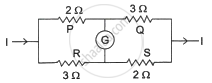
With an unknown resistance X in the left gap and a resistance of 30 Ω of the gap of a metre bridge, the null point is obtained at 40 cm from the left end of the wire. Find the unknown resistance. Also, find the shift in the null point when resistance in each gap is shunted by a resistance of 8 Ω.
Draw a neat labelled diagram to determine unknown resistance using a meter bridge.
Find the radius of the wire of length 25m needed to prepare a coil of resistance 25Ω. (Resistivity of material of wire is 3.142 x 10⁻⁷Ωm)
Four resistances 4Ω, 4Ω, 4Ω and 12Ω form a Wheatstone's network. Find the resistance which when connected across the 12Ω resistance will balance the network.
In the given Wheatstone's network, what should be the value of R for the network to be balanced?
Write balancing condition of a Wheatstone bridge.
What is the condition called when the galvanometer shows zero deflection in a Wheatstone bridge, with \[I_g = 0\]?
What is the main usefulness of a balanced Wheatstone bridge?
Which of the following is a device that operates on the Wheatstone bridge principle?
What would happen if the galvanometer in a Wheatstone bridge were replaced with a voltmeter?
In a Wheatstone bridge with \[R_1 = 200 \Omega\], \[R_2 = 300 \Omega\], and \[R_3 = 120 \Omega\], what is the value of the unknown resistance \[R_4\]?
