Advertisements
Advertisements
प्रश्न
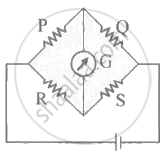
Four resistances 6Ω, 6Ω, 6Ω and 18Ω form a Wheatstone bridge. Find the resistance which connected across the 18Ω resistance will balance the network.
Advertisements
उत्तर
Given: P = Q = R = 6 Ω
To find: Resistance (X)
Formula: `"P"/"Q" = "R"/"S"`
Calculation:
Let resistance connected across 18 Ω be X.
Equivalent resistance for 18 Ω and X in parallel is given by,
X' = S = `(18"X")/(18 + "X")`
From formula,
`6/6 = 6/((18"X")/(18 + "X"))`
∴ 1 = `(6(18 + "X"))/(18"X")`
∴ 18X = 108 + 6X
∴ 12X = 108
∴ X = 9 Ω
The resistance connected across 18 Ω resistance to balance the network is 9 Ω.
APPEARS IN
संबंधित प्रश्न
Four resistances 4Ω,8Ω,XΩ, and 6Ω are connected in a series so as to form Wheatstone’s
network. If the network is balanced, find the value of ‘X’.
With the help of a labelled diagram, show that the balancing condition of a Wheatstone bridge is
`R_1/R_2 = R_3/R_4` where the terms have their usual meaning.
Explain with a neat circuit diagram. How you will determine the unknown resistances using a meter bridge.
The current which flows in a galvanometer of Wheatstone bridge is directly proportional to ______
In a metre bridge experiment. the ratio of the left-gap resistance to right gap resistance is 2: 3. The balance point from the left is ______.
In Wheatstone's bridge P = 7 ohm, Q = 12 ohm, R = 3 ohm and S = 8 ohm. How much resistance must be put in parallel to the resistance S to balance the bridge?
In Wheatstone's network p = 2 `Omega` , Q = 2 `Omega`, R = 2 `Omega` and S = 3 `Omega`. The resistance with which S is to be shunted in order that the bridge may be balanced is ______.
In the Wheatstone bridge, (shown in the figure) X = Y and A > B. The direction of the current between a and b will be ____________.

When the value of R in the balanced Wheatstone bridge, shown in the figure, is increased from 5 `Omega` to 7 `Omega`, the value of s has to be increased by 3 `Omega` in order to maintain the balance. What is the initial value of S?
A resistance of 5 `Omega` is connected in the left gap of a metre bridge and 15 `Omega` in the other gap. The position of the balancing point is ____________.
In following figure, a current of 1.4 A flows towards the bridge circuit. The current in 2 n resistor is ______.
Two resistances prepared from the wire of the same material having diameters in the ratio 2 : 1 and lengths in the ratio 2 : 1 are connected in the left gap and right gap of Wheatstone's meter bridge respectively. The distance of the null point from the left end of the wire is ______
In a balanced metre bridge, 5 Ω is connected in the left gap and R Ω in the right gap. When R Ω is shunted with equal resistance, the new balance point is at 1.6 I1 where 'I1' is the earlier balancing length. The value of 'I1' is ______
In a meter bridge experiment, to minimize an error due to contact resistance, ______
When an unknown resistance 'X' is connected in the left gap of a meter bridge and a known resistance 'R' in the right gap, a null point is obtained at 40 cm from the left end. If a 2 Ω resistance is connected in series with 'X' the null point shifts towards the right by 10 cm, with some resistance in the right gap. The value of 'X' must be ______
The figure below shows a balanced Wheatstone network. If it is disturbed by changing P to 22Ω, then which of the following steps will bring the bridge again to a balanced state?
Find the radius of the wire of length 25m needed to prepare a coil of resistance 25Ω. (Resistivity of material of wire is 3.142 x 10⁻⁷Ωm)
Four resistances 4Ω, 4Ω, 4Ω and 12Ω form a Wheatstone's network. Find the resistance which when connected across the 12Ω resistance will balance the network.
Two resistances are connected in two gaps of a meter bridge. The null point is obtained at 20 cm from zero end. A resistance of 15 is connected in series with smaller of the two. The null point shifts to 40 cm. The smaller resistance used in is ______.
What is the mathematical expression for the balance condition of a Wheatstone bridge?
Which of the following is NOT a characteristic of a balanced Wheatstone bridge?
What does 'null deflection' mean in the context of a Wheatstone bridge?
What is the balance condition used to find the variable resistor Q?
Which of the following is a device that operates on the Wheatstone bridge principle?
Why is high accuracy achievable in Wheatstone bridge measurements?
What would happen if the galvanometer in a Wheatstone bridge were replaced with a voltmeter?
