Advertisements
Advertisements
प्रश्न
Four resistances 6Ω, 6Ω, 6Ω and 18Ω form a Wheatstone bridge. Find the resistance which connected across the 18Ω resistance will balance the network.
Advertisements
उत्तर
Given: P = Q = R = 6 Ω
To find: Resistance (X)
Formula: `"P"/"Q" = "R"/"S"`
Calculation:
Let resistance connected across 18 Ω be X.
Equivalent resistance for 18 Ω and X in parallel is given by,
X' = S = `(18"X")/(18 + "X")`
From formula,
`6/6 = 6/((18"X")/(18 + "X"))`
∴ 1 = `(6(18 + "X"))/(18"X")`
∴ 18X = 108 + 6X
∴ 12X = 108
∴ X = 9 Ω
The resistance connected across 18 Ω resistance to balance the network is 9 Ω.
APPEARS IN
संबंधित प्रश्न
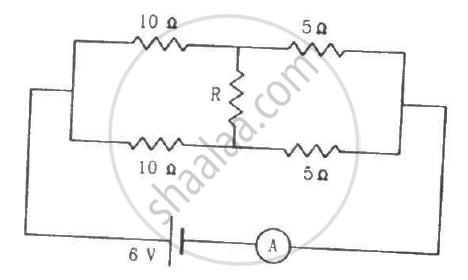
What should be the value of R in the figure for which the current in it is zero?
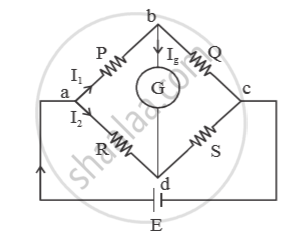
Obtain the balancing condition for the Wheatstone bridge arrangements as shown in Figure 4 below:
Choose the correct:
Four resistances 10 Ω, 10 Ω, 10 Ω and 15 Ω form a Wheatstone’s network. What shunt is required across 15 Ω resistor to balance the bridge
In Wheatstone’s meter-bridge experiment, the null point is obtained in the middle one-third portion of the wire. Why is it recommended?
State any two sources of errors in the meter-bridge experiment. Explain how they can be minimized.
With resistances P and Q placed in the left and right gaps of a metre bridge, the balance point divides the wire in the ratio of 1/3. When P and Q are increased by 40 n each. the balance point divides the wire in the ratio of 3/5. The values of P and Q will be respectively, ______
In a metre bridge experiment, the null point is obtained at 20 cm from one end of the wire when resistance X is balanced against another resistance Y. If X < Y, then where will be the new position of the null point from the same end, if one decides to balance a resistance of 4X against Y?
In Wheatstone's bridge P = 7 ohm, Q = 12 ohm, R = 3 ohm and S = 8 ohm. How much resistance must be put in parallel to the resistance S to balance the bridge?
On interchanging the resistances, the balance point of a metre bridge shifts to the left by 10 cm. The resistance of their series combination is 1 k`Omega`. How much was the resistance on the left slot before interchanging the resistances?
What is the e.m.f of the cell C in the circuit shown in figure, if the deflection in the galvanometer is zero, the resistance of the wire is 3 `Omega`, The length of the wire is 100 cm?

The potential difference between the points A and B in the electric circuit shown is ______.

In the meter bridge experiment, a null point was obtained at a distance of ℓ from the left end. The values of resistances in the left and right gaps are doubled and then interchanged. The new position of a null point is ______
In a metre bridge experiment, the ratio of the left-gap resistance to right gap resistance is 2: 3. The balance point from the left is ______.
A resistance R is to be measured using a meter bridge. Student chooses the standard resistance S to be 100Ω. He finds the null point at l1 = 2.9 cm. He is told to attempt to improve the accuracy. Which of the following is a useful way?
The measurement of an unknown resistance R is to be carried out using Wheatstones bridge (figure). Two students perform an experiment in two ways. The first students takes R2 = 10 Ω and R1 = 5 Ω. The other student takes R2 = 1000 Ω and R1 = 500 Ω. In the standard arm, both take R3 = 5 Ω. Both find R = `R_2/R_1 R_3` = 10 Ω within errors.
- The errors of measurement of the two students are the same.
- Errors of measurement do depend on the accuracy with which R2 and R1 can be measured.
- If the student uses large values of R2 and R1, the currents through the arms will be feeble. This will make determination of null point accurately more difficult.
- Wheatstone bridge is a very accurate instrument and has no errors of measurement.
A resistance of 20 Ω is connected in the left gap of a meter bridge and an unknown resistance greater than 20 Ω is connected in the right gap. When these resistances are interchanged, the balance point shifts by 20 cm. The unknown resistance is ______.
The figure below shows a balanced Wheatstone network. If it is disturbed by changing P to 22Ω, then which of the following steps will bring the bridge again to a balanced state?
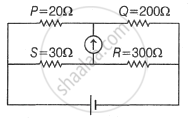
Find the radius of the wire of length 25m needed to prepare a coil of resistance 25Ω. (Resistivity of material of wire is 3.142 x 10⁻⁷Ωm)
In the given Wheatstone's network, what should be the value of R for the network to be balanced?
The current passing through the battery in the given circuit is:
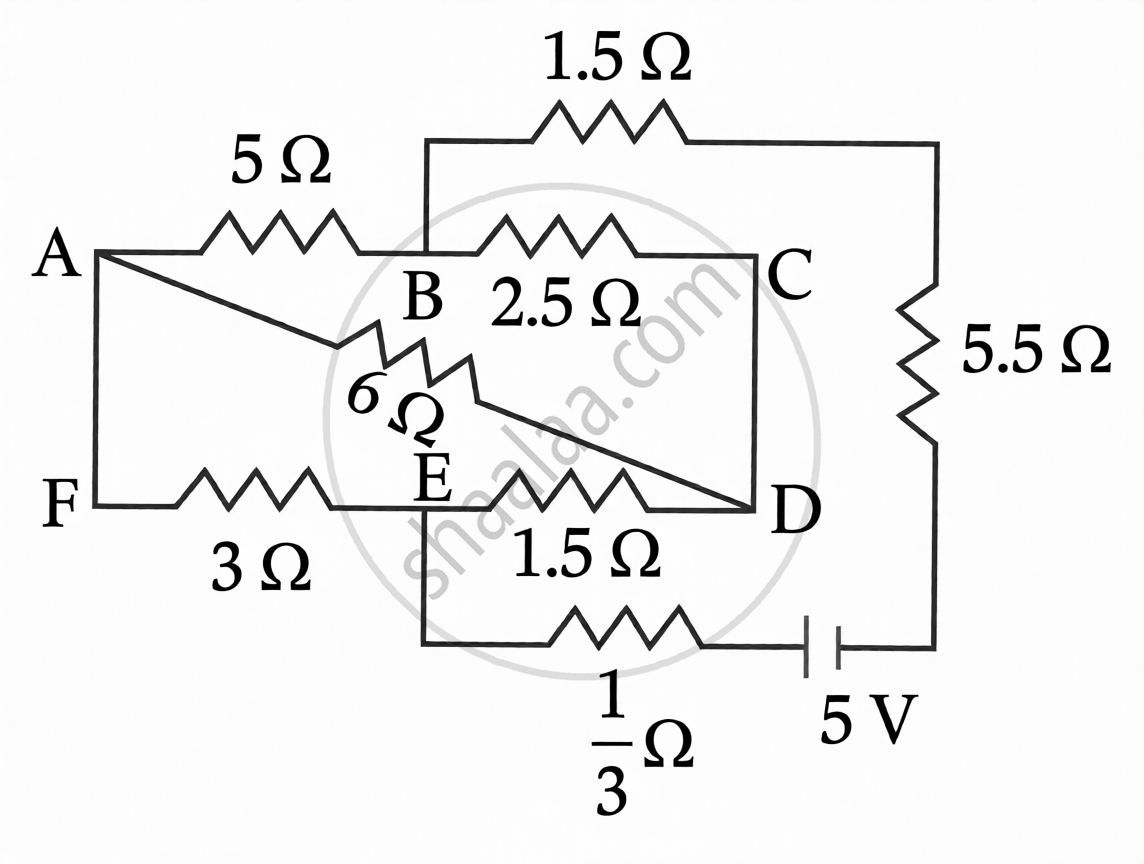
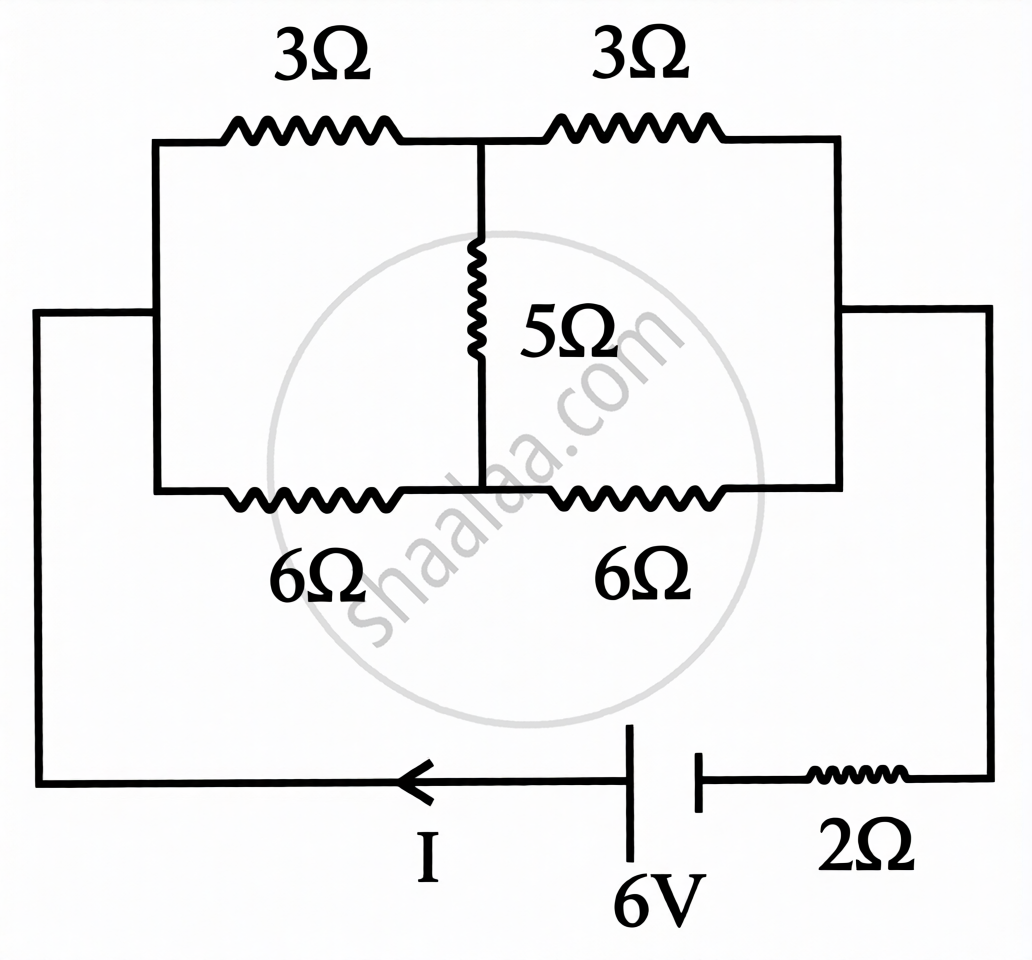
A battery of 6 V is connected to the circuit as shown below. The current I drawn from the battery is:
Which diagonal in a Wheatstone bridge serves as the galvanometer arm?
Which of the following is NOT a characteristic of a balanced Wheatstone bridge?
What is the main difference between a balanced and an unbalanced Wheatstone bridge in terms of galvanometer deflection?
What is the role of the battery arm in a Wheatstone bridge circuit?
Why is high accuracy achievable in Wheatstone bridge measurements?
What would happen if the galvanometer in a Wheatstone bridge were replaced with a voltmeter?
