Advertisements
Advertisements
प्रश्न
In Wheatstone’s meter-bridge experiment, the null point is obtained in the middle one-third portion of the wire. Why is it recommended?
Advertisements
उत्तर
- Due to the non-uniformity of the bridge wire and the development of contact resistance at the wire's ends, the value of unknown resistance X may not be accurate.
- To reduce these errors, the value of R is modified so that the null point is found in the middle one-third of the wire (between 34 and 66 cm), resulting in the smallest and virtually identical percentage errors in the measurement of lx and lR.
APPEARS IN
संबंधित प्रश्न
What should be the value of R in the figure for which the current in it is zero?
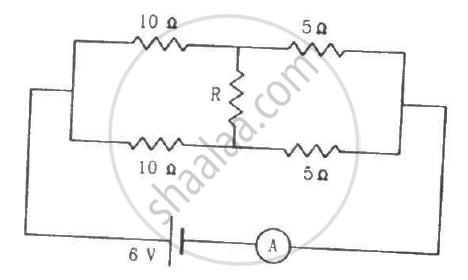
Choose the correct:
Four resistances 10 Ω, 10 Ω, 10 Ω and 15 Ω form a Wheatstone’s network. What shunt is required across 15 Ω resistor to balance the bridge
In conversion of moving coil galvanometer into an ammeter of required range, the resistance of ammeter, so formed is ______.
[S = shunt and G = resistance of galvanometer]
Two wires A and B of equal lengths are connected in left and right gap of a meter bridge, null point is obtained at 40 cm from left end. Diameters of the wire A and B are in that ratio 3 : 1. The ratio of specific resistance of A to the of B is ____________.
With a resistance of 'X' in the left gap and a resistance of 9 Ω in the right gap of a meter bridge, the balance point is obtained at 40 cm from the left end.
In what way and to which resistance 3 Ω resistance be connected to obtain the balance at 50 cm from the left end?
The metre bridge works on the principle of ______.
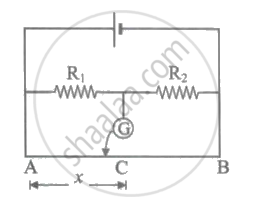
In the metre bridge experiment shown in the figure, the balance length AC corresponding to null deflection of the galvanometer is x. What would be the balance length if the radius of the wire AB is doubled?
In Wheatstone's network p = 2 `Omega` , Q = 2 `Omega`, R = 2 `Omega` and S = 3 `Omega`. The resistance with which S is to be shunted in order that the bridge may be balanced is ______.
In the Wheatstone bridge, (shown in the figure) X = Y and A > B. The direction of the current between a and b will be ____________.

The potential difference between the points A and B in the electric circuit shown is ______.

Which among the following resistances can be determined by a metre bridge?
Two resistances prepared from the wire of the same material having diameters in the ratio 2 : 1 and lengths in the ratio 2 : 1 are connected in the left gap and right gap of Wheatstone's meter bridge respectively. The distance of the null point from the left end of the wire is ______
ln, a Wheatstone network, P = Q = R = 8 `Omega` and S is 10 `Omega`. The required resistance to be connected to S so that network is balanced is ______.
The resistances in left and right gap of a meter-bridge are 3 `Omega` and 5 `Omega` respectively. When the resistance in the left gap is increased by 10%, the balance point shifts nearly by ______.
In a Wheatstone's bridge, the resistance in the three arms are P, Q, R, and its fourth arm has a parallel combination of two resistances S1 and S2, The balancing condition of the bridge is ______
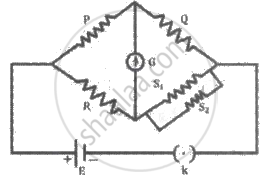
- Assertion (A): The given figure does not show a balanced Wheatstone bridge.
- Reason (R): For a balanced bridge small current should flow through the galvanometer.
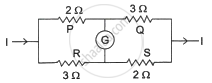
With an unknown resistance X in the left gap and a resistance of 30 Ω of the gap of a metre bridge, the null point is obtained at 40 cm from the left end of the wire. Find the unknown resistance. Also, find the shift in the null point when resistance in each gap is shunted by a resistance of 8 Ω.
Draw a neat labelled diagram to determine unknown resistance using a meter bridge.
Find the radius of the wire of length 25m needed to prepare a coil of resistance 25Ω. (Resistivity of material of wire is 3.142 x 10⁻⁷Ωm)
What is the galvanometer current in a balanced Wheatstone bridge?
What is the main difference between a balanced and an unbalanced Wheatstone bridge in terms of galvanometer deflection?
In an unbalanced Wheatstone bridge, which approach must be used to find the galvanometer current?
What is the role of the battery arm in a Wheatstone bridge circuit?
What is the main usefulness of a balanced Wheatstone bridge?
What does an unbalanced Wheatstone bridge indicate in a network?
What is the balance condition used to find the variable resistor Q?
