Advertisements
Advertisements
Question
In Wheatstone’s meter-bridge experiment, the null point is obtained in the middle one-third portion of the wire. Why is it recommended?
Advertisements
Solution
- Due to the non-uniformity of the bridge wire and the development of contact resistance at the wire's ends, the value of unknown resistance X may not be accurate.
- To reduce these errors, the value of R is modified so that the null point is found in the middle one-third of the wire (between 34 and 66 cm), resulting in the smallest and virtually identical percentage errors in the measurement of lx and lR.
APPEARS IN
RELATED QUESTIONS
With the help of a labelled diagram, show that the balancing condition of a Wheatstone bridge is
`R_1/R_2 = R_3/R_4` where the terms have their usual meaning.
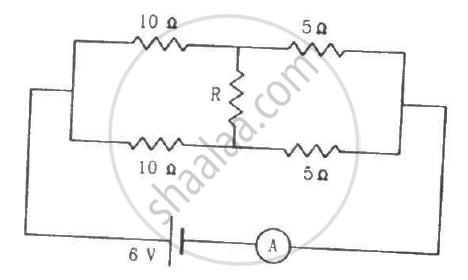
What should be the value of R in the figure for which the current in it is zero?
State any two sources of errors in the meter-bridge experiment. Explain how they can be minimized.
Two wires A and B of equal lengths are connected in left and right gap of a meter bridge, null point is obtained at 40 cm from left end. Diameters of the wire A and B are in that ratio 3 : 1. The ratio of specific resistance of A to the of B is ____________.
In a metre bridge experiment, the null point is obtained at 20 cm from one end of the wire when resistance X is balanced against another resistance Y. If X < Y, then where will be the new position of the null point from the same end, if one decides to balance a resistance of 4X against Y?
With a resistance of 'X' in the left gap and a resistance of 9 Ω in the right gap of a meter bridge, the balance point is obtained at 40 cm from the left end.
In what way and to which resistance 3 Ω resistance be connected to obtain the balance at 50 cm from the left end?
The metre bridge works on the principle of ______.
In the Wheatstone bridge, (shown in the figure) X = Y and A > B. The direction of the current between a and b will be ____________.

What is the e.m.f of the cell C in the circuit shown in figure, if the deflection in the galvanometer is zero, the resistance of the wire is 3 `Omega`, The length of the wire is 100 cm?

In the network shown cell E has internal resistance r and the galvanometer shows zero deflection. If the cell is replaced by a new cell of emf 2E and internal resistance 3r keeping everything else identical, then ______.

In the measurement of a resistance by the Wheatstone bridge, the known and the unknown resistance are interchanged to eliminate ____________.
In a meter bridge experiment, to minimize an error due to contact resistance, ______
The Wheatstone bridge is in a more balanced state when the ratio of arms P and Q is ______
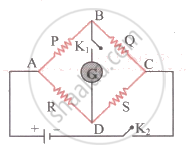
The figure below shows a balanced Wheatstone network. If it is disturbed by changing P to 22Ω, then which of the following steps will bring the bridge again to a balanced state?
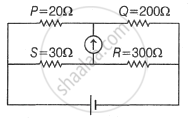
With an unknown resistance X in the left gap and a resistance of 30 Ω of the gap of a metre bridge, the null point is obtained at 40 cm from the left end of the wire. Find the unknown resistance. Also, find the shift in the null point when resistance in each gap is shunted by a resistance of 8 Ω.
Find the radius of the wire of length 25m needed to prepare a coil of resistance 25Ω. (Resistivity of material of wire is 3.142 x 10⁻⁷Ωm)
Four resistances 4Ω, 4Ω, 4Ω and 12Ω form a Wheatstone's network. Find the resistance which when connected across the 12Ω resistance will balance the network.
In a Wheatstone’s bridge, three resistances P, Q and R connected in the three arms and the fourth arm is formed by two resistances S1 and S2 connected in parallel. The condition for the bridge to be balanced will be ______.
What is the condition called when the galvanometer shows zero deflection in a Wheatstone bridge, with \[I_g = 0\]?
What is the mathematical expression for the balance condition of a Wheatstone bridge?
Which diagonal in a Wheatstone bridge serves as the galvanometer arm?
What does an unbalanced Wheatstone bridge indicate in a network?
Based on the balance condition, if \[R_1 = 100 \Omega\], \[R_2 = 200 \Omega\], and \[R_3 = 50 \Omega\], what must \[R_4\] be for the bridge to be balanced?
