Advertisements
Advertisements
प्रश्न
Explain with a neat circuit diagram. How you will determine the unknown resistances using a meter bridge.
Explain with a neat circuit diagram how will you determine unknown resistance ‘X’ by using meter bridge.
With the help of neat labelled circuit diagram explain the use of metre bridge to determine unknown resistance.
Advertisements
उत्तर

Construction: Metrebridge consists of a one-metre-long wire of uniform cross-section, stretched on a metre scale which is fixed on a wooden table. The ends of the wire are fixed below two L shaped metallic strips. A single metallic stripe separates the two L-shaped strips leaving two gaps, left gap and right gap. Usually, an unknown resistance X is connected in the left gap and a resistance box is connected in the other gap. One terminal of a galvanometer is connected to point C on the central strip, while the other terminal of the galvanometer carries the jockey (J). Temporary contact with the wire AB can be established with the help of the jockey. A cell of emf E along with a key and a rheostat is connected between points A and B.
Working: A suitable resistance R is selected from the resistance box. The jockey is brought in contact with AB at various points on the wire AB and the balance point (null point), D is obtained. The galvanometer shows no deflection when the jockey is at the balance point (point D). The distances lx and lR of the null point from the two ends of the wire are measured.
Then, using the balancing conditions,
`X/R = R_(AD)/R_(DB)` ...(1)
where RAD and RDB are the resistances of parts AD and DB of the wire, respectively.
If l is the length of the wire, ρ is its specific resistance, and A is its area of cross-section, then
`R_AD = (rhol_x)/A` ...(2)
`R_DB = (rhol_R)/A` ...(3)
From equations (1), (2) and (3),
`X/R = R_(AD)/R_(DC) = (rhol_x/A)/(rhol_R/A)`
∴ `X/R = l_x/l_R`
∴ X = `l_x/l_R R`
Thus, knowing R, lx and lR, the value of the unknown resistance can be determined.
APPEARS IN
संबंधित प्रश्न
In a meter bridge, two unknown resistances R and S, when connected between the two gaps, give a null point is 60 cm from one end. What is the ratio of R and S?
The current which flows in a galvanometer of Wheatstone bridge is directly proportional to ______
With resistances P and Q placed in the left and right gaps of a metre bridge, the balance point divides the wire in the ratio of 1/3. When P and Q are increased by 40 n each. the balance point divides the wire in the ratio of 3/5. The values of P and Q will be respectively, ______
In the circuit shown, a metre bridge is in its balanced state. The metre bridge wire has a resistance 0.1 ohm/cm. The value of unknown resistance X and the current drawn from the battery of negligible resistance are ____________.

In Wheatstone's bridge P = 7 ohm, Q = 12 ohm, R = 3 ohm and S = 8 ohm. How much resistance must be put in parallel to the resistance S to balance the bridge?
The resistances in left and right gap of a metrebridge are 20 `Omega` and 30 `Omega` respectively. When the resistance in the left gap is reduced to half its value, the balance point shifts by ______.
What is the e.m.f of the cell C in the circuit shown in figure, if the deflection in the galvanometer is zero, the resistance of the wire is 3 `Omega`, The length of the wire is 100 cm?

In the network shown cell E has internal resistance r and the galvanometer shows zero deflection. If the cell is replaced by a new cell of emf 2E and internal resistance 3r keeping everything else identical, then ______.

A resistance of 5 `Omega` is connected in the left gap of a metre bridge and 15 `Omega` in the other gap. The position of the balancing point is ____________.
The potential difference between the points A and B in the electric circuit shown is ______.

In a balanced metre bridge, 5 Ω is connected in the left gap and R Ω in the right gap. When R Ω is shunted with equal resistance, the new balance point is at 1.6 I1 where 'I1' is the earlier balancing length. The value of 'I1' is ______
In the meter bridge experiment, a null point was obtained at a distance of ℓ from the left end. The values of resistances in the left and right gaps are doubled and then interchanged. The new position of a null point is ______
ln, a Wheatstone network, P = Q = R = 8 `Omega` and S is 10 `Omega`. The required resistance to be connected to S so that network is balanced is ______.
The current through 1 `Omega` resistance in the following circuit is ______.

A resistance R is to be measured using a meter bridge. Student chooses the standard resistance S to be 100Ω. He finds the null point at l1 = 2.9 cm. He is told to attempt to improve the accuracy. Which of the following is a useful way?
The measurement of an unknown resistance R is to be carried out using Wheatstones bridge (figure). Two students perform an experiment in two ways. The first students takes R2 = 10 Ω and R1 = 5 Ω. The other student takes R2 = 1000 Ω and R1 = 500 Ω. In the standard arm, both take R3 = 5 Ω. Both find R = `R_2/R_1 R_3` = 10 Ω within errors.
- The errors of measurement of the two students are the same.
- Errors of measurement do depend on the accuracy with which R2 and R1 can be measured.
- If the student uses large values of R2 and R1, the currents through the arms will be feeble. This will make determination of null point accurately more difficult.
- Wheatstone bridge is a very accurate instrument and has no errors of measurement.
The figure below shows a balanced Wheatstone network. If it is disturbed by changing P to 22Ω, then which of the following steps will bring the bridge again to a balanced state?
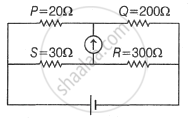
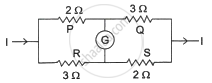
- Assertion (A): The given figure does not show a balanced Wheatstone bridge.
- Reason (R): For a balanced bridge small current should flow through the galvanometer.
Draw a neat labelled diagram of Kelvin's meter bridge circuit for the measurement of galvanometer resistance.
Four resistances 4Ω, 4Ω, 4Ω and 12Ω form a Wheatstone's network. Find the resistance which when connected across the 12Ω resistance will balance the network.
Write balancing condition of a Wheatstone bridge.
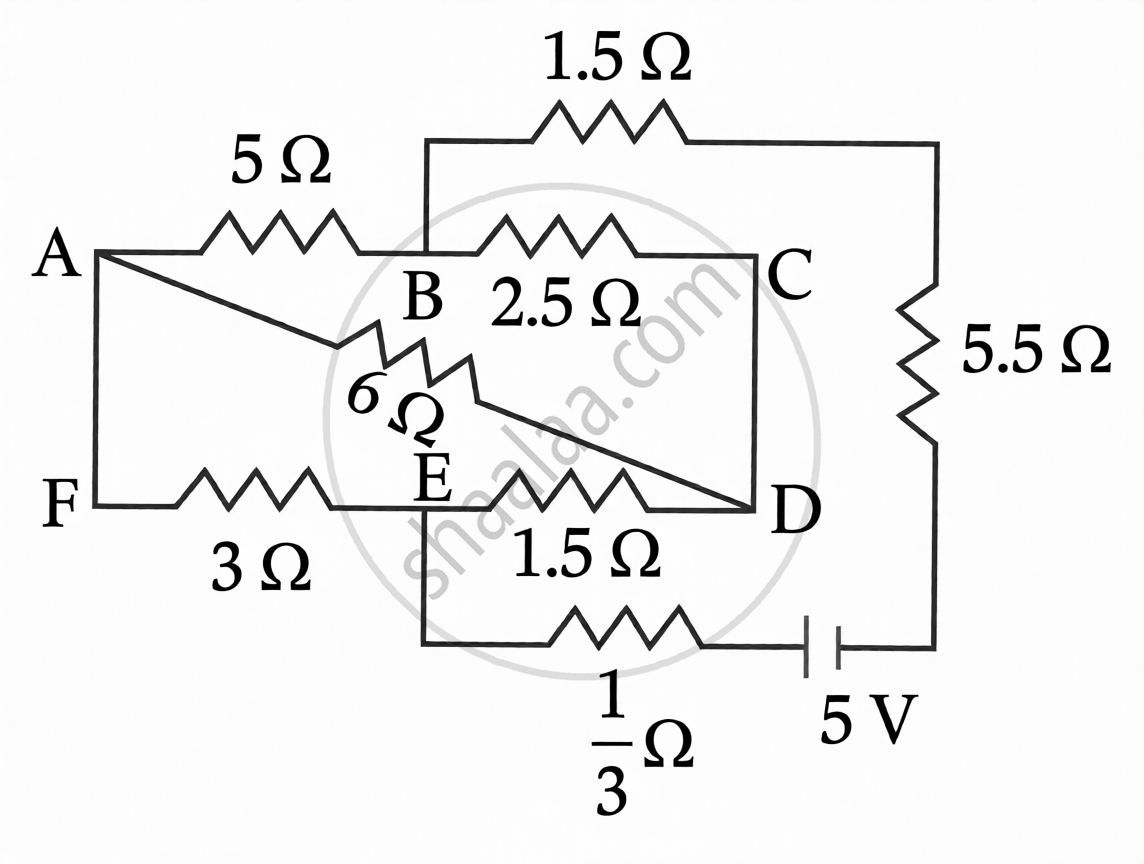
The current passing through the battery in the given circuit is:
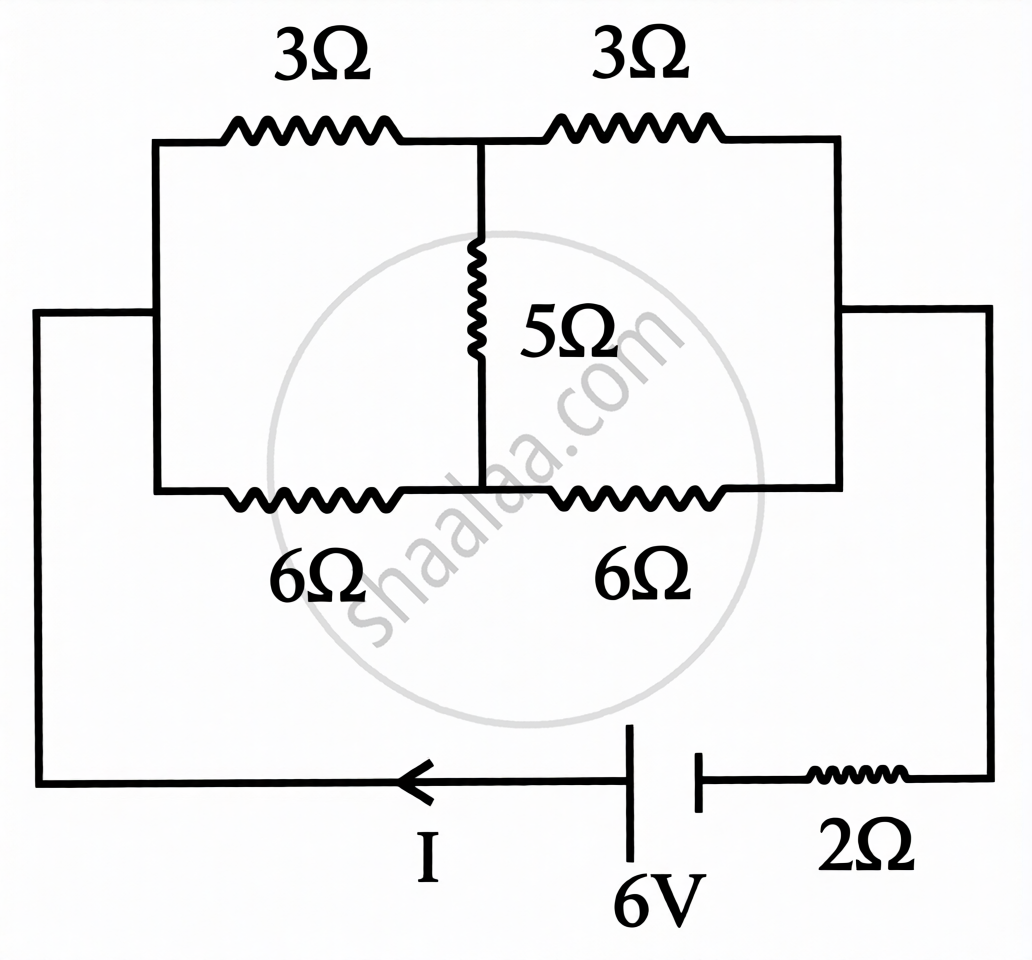
A battery of 6 V is connected to the circuit as shown below. The current I drawn from the battery is:
In a Wheatstone bridge, what happens when the galvanometer shows zero deflection?
What is the galvanometer current in a balanced Wheatstone bridge?
What does an unbalanced Wheatstone bridge indicate in a network?
Why is high accuracy achievable in Wheatstone bridge measurements?
