Advertisements
Advertisements
Question
A point charge q moving with speed v enters a uniform magnetic field B that is acting into the plane of the paper as shown. What is the path followed by the charge q and in which plane does it move?
Advertisements
Solution
When a charged particle having charge q moves inside a magnetic field \[\vec{B}\] with velocity v, it experiences a force `vecF=q(vecv xx vecB).`
When
\[\vec{v}\] is perpendicular to \[\vec{B}\] the force \[\vec{F}\] on the charged particle acts as the centripetal force and makes it move along a circular path.
The point charge travels in the plane perpendicular to both \[\vec{v}\] and \[\vec{B}\].
APPEARS IN
RELATED QUESTIONS
Find the condition under which the charged particles moving with different speeds in the presence of electric and magnetic field vectors can be used to select charged particles of a particular speed.
The motion of copper plate is damped when it is allowed to oscillate between the two poles of a magnet. What is the cause of this damping?
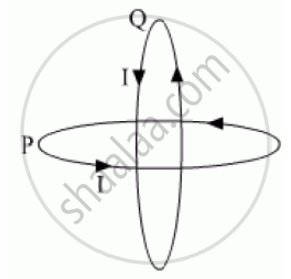
Two identical circular wires P and Q each of radius R and carrying current ‘I’ are kept in perpendicular planes such that they have a common centre as shown in the figure. Find the magnitude and direction of the net magnetic field at the common centre of the two coils.
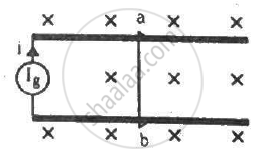
The current generator Ig' shown in figure, sends a constant current i through the circuit. The wire ab has a length l and mass m and can slide on the smooth, horizontal rails connected to Ig. The entire system lies in a vertical magnetic field B. Find the velocity of the wire as a function of time.
A beam of protons with speed 4 × 10⁵ ms-1 enters a uniform magnetic field of 0.3 T at an angle of 60° to the magnetic field. The pitch of the resulting helical path of protons is close to :
(Mass of the proton = 1.67 × 10⁻²⁷ kg, charge of the proton = 1.69 × 10⁻¹⁹ C)
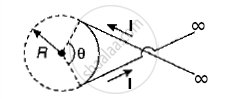
A wire carrying current i has the configuration shown in figure. For the magnetic field to be zero at the centre of the circle, θ must be:
A charged particle of charge q and mass m is projected in a region that contains an electric and magnetic field as shown in the figure with velocity V at an angle of 45° with x-direction. If V = `sqrt((qE)/m)`, then net deviation in particle motion will be (neglect the effect of gravity) in a clockwise direction approx ______ °.

A charged particle enters a magnetic field \[\vec B\] with velocity \[\vec v\] such that the angle between them is 90°. What type of path does the particle follow?
The angular frequency of revolution of a charged particle in a magnetic field is given by:
The time period of revolution of a charged particle in a uniform magnetic field is:
