Advertisements
Advertisements
प्रश्न
A point charge q moving with speed v enters a uniform magnetic field B that is acting into the plane of the paper as shown. What is the path followed by the charge q and in which plane does it move?
Advertisements
उत्तर
When a charged particle having charge q moves inside a magnetic field \[\vec{B}\] with velocity v, it experiences a force `vecF=q(vecv xx vecB).`
When
\[\vec{v}\] is perpendicular to \[\vec{B}\] the force \[\vec{F}\] on the charged particle acts as the centripetal force and makes it move along a circular path.
The point charge travels in the plane perpendicular to both \[\vec{v}\] and \[\vec{B}\].
APPEARS IN
संबंधित प्रश्न
Find the condition under which the charged particles moving with different speeds in the presence of electric and magnetic field vectors can be used to select charged particles of a particular speed.
Show with the help of a diagram how the force between the two conductors would change when the currents in them flow in the opposite directions?
The motion of copper plate is damped when it is allowed to oscillate between the two poles of a magnet. What is the cause of this damping?
Consider a long, straight wire of cross-sectional area A carrying a current i. Let there be n free electrons per unit volume. An observer places himself on a trolley moving in the direction opposite to the current with a speed \[v = \frac{i}{\text{nAe}}\] and separation from the wire by a distance r. The magnetic field seen by the observer is very nearly
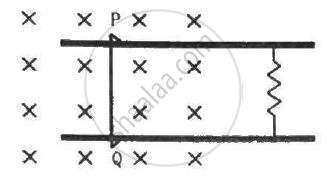
Consider the situation shown in figure. The wire PQ has mass m, resistance r and can slide on the smooth, horizontal parallel rails separated by a distance l. The resistance of the rails is negligible. A uniform magnetic field B exists in the rectangular region and a resistance R connects the rails outside the field region. At t = 0, the wire PQ is pushed towards right with a speed v0. Find (a) the current in the loop at an instant when the speed of the wire PQ is v, (b) the acceleration of the wire at this instant, (c) the velocity vas a functions of x and (d) the maximum distance the wire will move.
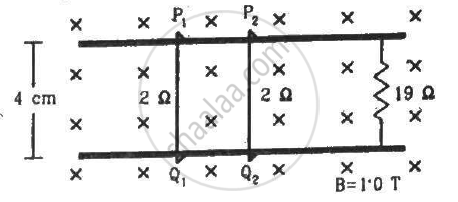
Consider the situation shown in figure. The wires P1Q1 and P2Q2 are made to slide on the rails with the same speed 5 cm s−1. Suppose the 19 Ω resistor is disconnected. Find the current through P2Q2 if (a) both the wires move towards right and (b) if P1Q1 moves towards left but P2Q2 moves towards right.
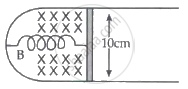
A thin strip 10 cm long is on a U-shaped wire of negligible resistance and it is connected to a spring of spring constant 0.5 Nm-1. The assembly is kept in a uniform magnetic field of 0.1 T. If the strip is pulled from its equilibrium position and released, the number of oscillations it performs before its amplitude decreases by a factor of e is N. If the mass of the strip is 50 grams, its resistance is 10 Ω, and air drag is negligible, N will be close to ______.
A charged particle is accelerated through a potential difference of 12 kV and acquires a speed of 106 ms-1. It is projected perpendicularly into the magnetic field of strength 0.2 T. The radius of the circle described is ______ cm.
A charge Q is moving `vec"dl"` distance in the magnetic field `vec"B"`. Find the value of work done by `vec"B"`.
The work done by the magnetic force on a moving charged particle is:
