Advertisements
Advertisements
प्रश्न
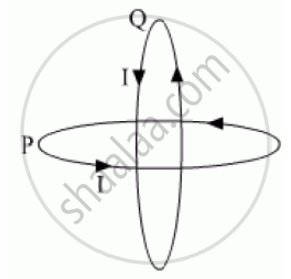
Two identical circular wires P and Q each of radius R and carrying current ‘I’ are kept in perpendicular planes such that they have a common centre as shown in the figure. Find the magnitude and direction of the net magnetic field at the common centre of the two coils.
Advertisements
उत्तर
Magnetic field at centre of circular loop carrying current I given
`B =(mu_0 I)/(2a)`
Here, a = R
Now, magnetic field due to loop Q
`B_Q = B_x = (mu_0I)/(2R)`
Magnetic field due to loop P.
`B_p = B_y = (mu_0I)/(2R)`
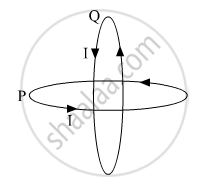
Net field at centre.
`B_N = sqrt(B_p^2 + B_Q^2)`
`= sqrt(((mu_0I)/(2R))^2 +sqrt(((mu_0I)/(2R))^2`
`(mu_0I)/(2R)sqrt2`
`B_N (mu_0I)/(sqrt2R)`
Direction of net magnetic field
tan`theta = B_p/B_Q =1`
`theta =pi/4`
APPEARS IN
संबंधित प्रश्न
Depict the behaviour of magnetic field lines in the presence of a diamagnetic material?
A charged particle moving in a magnetic field experiences a resultant force ______
A deuteron and an alpha particle having equal kinetic energy enter perpendicular into a magnetic field. Let `r_d` and `r_alpha` be their respective radii of the circular path. The value of `(r_d)/(r_alpha)` is equal to ______.
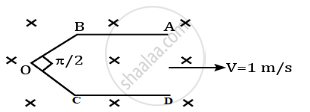
A conductor ABOCD moves along its bisector with a velocity 1 m/s through a perpendicular magnetic field of 1 wb/m2, as shown in figure. If all the four sides are 1 m length each, then the induced emf between A and Din approx is ______V.
A charged particle is accelerated through a potential difference of 12 kV and acquires a speed of 106 ms-1. It is projected perpendicularly into the magnetic field of strength 0.2 T. The radius of the circle described is ______ cm.
A charged particle of charge q and mass m is projected in a region that contains an electric and magnetic field as shown in the figure with velocity V at an angle of 45° with x-direction. If V = `sqrt((qE)/m)`, then net deviation in particle motion will be (neglect the effect of gravity) in a clockwise direction approx ______ °.

Which of the following statements about the magnetic force and electric force is TRUE regarding energy transfer to a charged particle?
The time period of revolution of a charged particle in a uniform magnetic field is:
A charged particle's velocity makes an angle θ with a magnetic field \[\vec B\], where 0° < θ < 90°. The perpendicular component of velocity \[v_\perp = v \sin\theta\] is responsible for:
