Advertisements
Advertisements
प्रश्न
When an ideal capacitor is charged by a dc battery, no current flows. However, when an ac source is used, the current flows continuously. How does one explain this, based on the concept of displacement current?
Advertisements
उत्तर
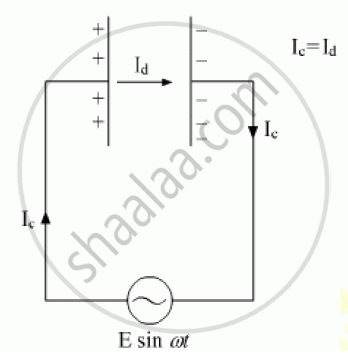
Ideal capacitor means infinite resistance for dc. When an ac source is used, the current flows continuously, but we know that the capacitor has dielectric (air) between its plates. So, ideally there is no current, and circuit would be incomplete. In real capacitor is charged due to contribution of varying electric field. The current between the capacitor plates is given by displacement current
`D = in E`
`I_d = in (dphi)/(dt) `
APPEARS IN
संबंधित प्रश्न
Displacement current is given by ______.
A capacitor of capacitance ‘C’, is connected across an ac source of voltage V, given by V = V0 sinωt The displacement current between the plates of the capacitor would then be given by ______.
The charge on a parallel plate capacitor varies as q = q0 cos 2πνt. The plates are very large and close together (area = A, separation = d). Neglecting the edge effects, find the displacement current through the capacitor?
Sea water at frequency ν = 4 × 10⁸ Hz has permittivity ε ≈ 80 εo, permeability µ ≈ µo and resistivity ρ = 0.25 Ω–m. Imagine a parallel plate capacitor immersed in seawater and driven by an alternating voltage source V(t) = Vo sin (2πνt). What fraction of the conduction current density is the displacement current density?
A long straight cable of length `l` is placed symmetrically along z-axis and has radius a(<< l). The cable consists of a thin wire and a co-axial conducting tube. An alternating current I(t) = I0 sin (2πνt) flows down the central thin wire and returns along the co-axial conducting tube. The induced electric field at a distance s from the wire inside the cable is E(s,t) = µ0I0ν cos (2πνt) In `(s/a)hatk`.
- Calculate the displacement current density inside the cable.
- Integrate the displacement current density across the cross-section of the cable to find the total displacement current Id.
- Compare the conduction current I0 with the displacement current `I_0^d`.
Draw a neat labelled diagram of displacement current in the space between the plates of the capacitor.
What does Faraday's Law establish in the comparison with displacement current?
For the charging capacitor, what does \[\varepsilon_0\frac{d\Phi_E}{dt}\] equal?
How do displacement current and conduction current compare in the charging capacitor?
How is displacement current relevant to MRI machines?
