Advertisements
Advertisements
Question
When an ideal capacitor is charged by a dc battery, no current flows. However, when an ac source is used, the current flows continuously. How does one explain this, based on the concept of displacement current?
Advertisements
Solution
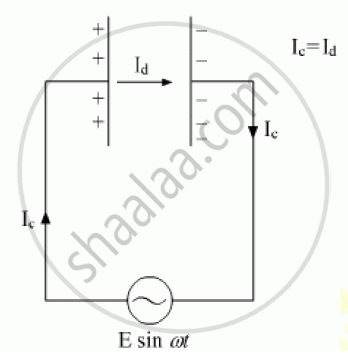
Ideal capacitor means infinite resistance for dc. When an ac source is used, the current flows continuously, but we know that the capacitor has dielectric (air) between its plates. So, ideally there is no current, and circuit would be incomplete. In real capacitor is charged due to contribution of varying electric field. The current between the capacitor plates is given by displacement current
`D = in E`
`I_d = in (dphi)/(dt) `
APPEARS IN
RELATED QUESTIONS
A capacitor has been charged by a dc source. What are the magnitude of conduction and displacement current, when it is fully charged?
Without the concept of displacement current it is not possible to correctly apply Ampere’s law on a path parallel to the plates of parallel plate capacitor having capacitance C in ______.
The displacement of a particle from its mean position is given by x = 4 sin (10πt + 1.5π) cos (10πt + 1.5π). The motion of the particle is
Displacement current goes through the gap between the plantes of a capacitors. When the charge of the capacitor:-
A parallel plate capacitor of plate separation 2 mm is connected in an electric circuit having source voltage 400 V. What is the value of the displacement current for 10-6 second if the plate area is 60 cm2?
A capacitor of capacitance ‘C’, is connected across an ac source of voltage V, given by
V = V0sinωt
The displacement current between the plates of the capacitor would then be given by:
The charge on a parallel plate capacitor varies as q = q0 cos 2πνt. The plates are very large and close together (area = A, separation = d). Neglecting the edge effects, find the displacement current through the capacitor?
A parallel plate capacitor is charged by connecting it to a battery through a resistor. If I is the current in the circuit, then in the gap between the plates, there is no conduction current:
What role does displacement current have in radio wave transmission?
How is displacement current relevant to MRI machines?
