Advertisements
Advertisements
Question
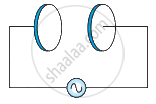
The charge on a parallel plate capacitor varies as q = q0 cos 2πνt. The plates are very large and close together (area = A, separation = d). Neglecting the edge effects, find the displacement current through the capacitor?
Advertisements
Solution
This displacement current through the capacitor is given by,
`I_d = I_c = (dq)/(dt)` ......(i)
Here we are given, q = q0 cos 2πνt
Putting this value in equation (i), we get
`I_d = I_c = - q_0 sin 2pivt xx 2 piv`
`I_d = I_c = - 2 pivq_0 sin 2pivt`
APPEARS IN
RELATED QUESTIONS
A parallel plate capacitor (Figure) made of circular plates each of radius R = 6.0 cm has a capacitance C = 100 pF. The capacitor is connected to a 230 V ac supply with a (angular) frequency of 300 rad s−1.
- What is the rms value of the conduction current?
- Is the conduction current equal to the displacement current?
- Determine the amplitude of B at a point 3.0 cm from the axis between the plates.
A parallel-plate capacitor of plate-area A and plate separation d is joined to a battery of emf ε and internal resistance R at t = 0. Consider a plane surface of area A/2, parallel to the plates and situated symmetrically between them. Find the displacement current through this surface as a function of time.
If the total energy of a particle executing SHM is E, then the potential energy V and the kinetic energy K of the particle in terms of E when its displacement is half of its amplitude will be ______.
A spring balance has a scale that reads 0 to 50 kg. The length of the scale is 20 cm. A body suspended from this spring, when displaced and released, oscillates with a period of 0.60 s. What is the weight of the body?
A cylinder of radius R, length Land density p floats upright in a fluid of density p0. The cylinder is given a gentle downward push as a result of which there is a vertical displacement of size x; it is then released; the time period of resulting (undampe (D) oscillations is ______.
The displacement of a particle from its mean position is given by x = 4 sin (10πt + 1.5π) cos (10πt + 1.5π). The motion of the particle is
Which of the following is the unit of displacement current?
A capacitor of capacitance ‘C’, is connected across an ac source of voltage V, given by
V = V0sinωt
The displacement current between the plates of the capacitor would then be given by:
You are given a 2 µF parallel plate capacitor. How would you establish an instantaneous displacement current of 1 mA in the space between its plates?
Sea water at frequency ν = 4 × 10⁸ Hz has permittivity ε ≈ 80 εo, permeability µ ≈ µo and resistivity ρ = 0.25 Ω–m. Imagine a parallel plate capacitor immersed in seawater and driven by an alternating voltage source V(t) = Vo sin (2πνt). What fraction of the conduction current density is the displacement current density?
A parallel plate capacitor is charged to 100 × 10-6 C. Due to radiations, falling from a radiating source, the plate loses charge at the rate of 2 × 10⁻⁷ Cs-1. The magnitude of displacement current is ______.
A parallel plate capacitor made of circular plates is being charged such that the surface charge density on its palates is increasing at a constant rate with time. The magnetic field arising due to displacement current is ______.
A parallel plate capacitor is charged by connecting it to a battery through a resistor. If I is the current in the circuit, then in the gap between the plates, there is no conduction current:
Which condition indicates that displacement current exists?
What is occurring between the plates of a charging capacitor despite there being no net charge movement through the gap?
What does Faraday's Law establish in the comparison with displacement current?
What role does displacement current have in radio wave transmission?
How is displacement current relevant to MRI machines?
