Advertisements
Advertisements
Question
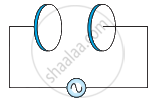
A variable frequency a.c source is connected to a capacitor. How will the displacement current change with decrease in frequency?
Advertisements
Solution
Capacitive reaction `X_C = 1/(2pi fC)`
Hence, `X_C oo 1/f`
As frequency decreases, `X_C` increases and the conduction current is inversely proportional to `X_C (because I oo 1/(X_C))`.
It means the displacement current decreases as the conduction current is equal to the displacement current.
APPEARS IN
RELATED QUESTIONS
A parallel plate capacitor (Figure) made of circular plates each of radius R = 6.0 cm has a capacitance C = 100 pF. The capacitor is connected to a 230 V ac supply with a (angular) frequency of 300 rad s−1.
- What is the rms value of the conduction current?
- Is the conduction current equal to the displacement current?
- Determine the amplitude of B at a point 3.0 cm from the axis between the plates.
A capacitor has been charged by a dc source. What are the magnitude of conduction and displacement current, when it is fully charged?
A parallel-plate capacitor of plate-area A and plate separation d is joined to a battery of emf ε and internal resistance R at t = 0. Consider a plane surface of area A/2, parallel to the plates and situated symmetrically between them. Find the displacement current through this surface as a function of time.
Displacement current is given by ______.
A parallel plate capacitor of plate separation 2 mm is connected in an electric circuit having source voltage 400 V. What is the value of the displacement current for 10-6 second if the plate area is 60 cm2?
According to Maxwell's hypothesis, a changing electric field gives rise to ______.
A capacitor of capacitance ‘C’, is connected across an ac source of voltage V, given by V = V0 sinωt The displacement current between the plates of the capacitor would then be given by ______
A capacitor of capacitance ‘C’, is connected across an ac source of voltage V, given by
V = V0sinωt
The displacement current between the plates of the capacitor would then be given by:
An electromagnetic wave travelling along z-axis is given as: E = E0 cos (kz – ωt.). Choose the correct options from the following;
- The associated magnetic field is given as `B = 1/c hatk xx E = 1/ω (hatk xx E)`.
- The electromagnetic field can be written in terms of the associated magnetic field as `E = c(B xx hatk)`.
- `hatk.E = 0, hatk.B` = 0.
- `hatk xx E = 0, hatk xx B` = 0.
The charge on a parallel plate capacitor varies as q = q0 cos 2πνt. The plates are very large and close together (area = A, separation = d). Neglecting the edge effects, find the displacement current through the capacitor?
Show that average value of radiant flux density ‘S’ over a single period ‘T’ is given by S = `1/(2cmu_0) E_0^2`.
Sea water at frequency ν = 4 × 10⁸ Hz has permittivity ε ≈ 80 εo, permeability µ ≈ µo and resistivity ρ = 0.25 Ω–m. Imagine a parallel plate capacitor immersed in seawater and driven by an alternating voltage source V(t) = Vo sin (2πνt). What fraction of the conduction current density is the displacement current density?
AC voltage V(t) = 20 sinωt of frequency 50 Hz is applied to a parallel plate capacitor. The separation between the plates is 2 mm and the area is 1 m2. The amplitude of the oscillating displacement current for the applied AC voltage is ______.
[take ε0 = 8.85 × 10⁻¹² F/m]
A parallel plate capacitor is charged by connecting it to a battery through a resistor. If I is the current in the circuit, then in the gap between the plates, there is no conduction current:
Where does conduction current flow as the capacitor charges?
What magnetic effect did Maxwell propose for a time-varying electric field?
What does Faraday's Law establish in the comparison with displacement current?
