Advertisements
Advertisements
प्रश्न
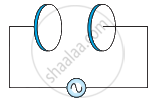
A variable frequency a.c source is connected to a capacitor. How will the displacement current change with decrease in frequency?
Advertisements
उत्तर
Capacitive reaction `X_C = 1/(2pi fC)`
Hence, `X_C oo 1/f`
As frequency decreases, `X_C` increases and the conduction current is inversely proportional to `X_C (because I oo 1/(X_C))`.
It means the displacement current decreases as the conduction current is equal to the displacement current.
APPEARS IN
संबंधित प्रश्न
A parallel plate capacitor (Figure) made of circular plates each of radius R = 6.0 cm has a capacitance C = 100 pF. The capacitor is connected to a 230 V ac supply with a (angular) frequency of 300 rad s−1.
- What is the rms value of the conduction current?
- Is the conduction current equal to the displacement current?
- Determine the amplitude of B at a point 3.0 cm from the axis between the plates.
A capacitor has been charged by a dc source. What are the magnitude of conduction and displacement current, when it is fully charged?
When an ideal capacitor is charged by a dc battery, no current flows. However, when an ac source is used, the current flows continuously. How does one explain this, based on the concept of displacement current?
A parallel-plate capacitor of plate-area A and plate separation d is joined to a battery of emf ε and internal resistance R at t = 0. Consider a plane surface of area A/2, parallel to the plates and situated symmetrically between them. Find the displacement current through this surface as a function of time.
Displacement current is given by ______.
If the total energy of a particle executing SHM is E, then the potential energy V and the kinetic energy K of the particle in terms of E when its displacement is half of its amplitude will be ______.
Displacement current goes through the gap between the plantes of a capacitors. When the charge of the capacitor:-
A parallel plate capacitor of plate separation 2 mm is connected in an electric circuit having source voltage 400 V. What is the value of the displacement current for 10-6 second if the plate area is 60 cm2?
According to Maxwell's hypothesis, a changing electric field gives rise to ______.
A capacitor of capacitance ‘C’, is connected across an ac source of voltage V, given by V = V0 sinωt The displacement current between the plates of the capacitor would then be given by ______.
The charge on a parallel plate capacitor varies as q = q0 cos 2πνt. The plates are very large and close together (area = A, separation = d). Neglecting the edge effects, find the displacement current through the capacitor?
You are given a 2 µF parallel plate capacitor. How would you establish an instantaneous displacement current of 1 mA in the space between its plates?
A particle is moving with speed v = b`sqrtx` along positive x-axis. Calculate the speed of the particle at time t = τ (assume that the particle is at origin at t = 0).
A parallel plate capacitor is charged to 100 × 10-6 C. Due to radiations, falling from a radiating source, the plate loses charge at the rate of 2 × 10⁻⁷ Cs-1. The magnitude of displacement current is ______.
In the Ampere–Maxwell Circuital Law, what produces a changing magnetic field in addition to current?
Which components form the charging capacitor circuit?
In the relay-race analogy, what picks up the baton when conduction current in the wire stops?
How do displacement current and conduction current compare in the charging capacitor?
How is displacement current relevant to MRI machines?
