Advertisements
Advertisements
Question
A long straight cable of length `l` is placed symmetrically along z-axis and has radius a(<< l). The cable consists of a thin wire and a co-axial conducting tube. An alternating current I(t) = I0 sin (2πνt) flows down the central thin wire and returns along the co-axial conducting tube. The induced electric field at a distance s from the wire inside the cable is E(s,t) = µ0I0ν cos (2πνt) In `(s/a)hatk`.
- Calculate the displacement current density inside the cable.
- Integrate the displacement current density across the cross-section of the cable to find the total displacement current Id.
- Compare the conduction current I0 with the displacement current `I_0^d`.
Advertisements
Solution
i. Induced electric field E(s, t) at distance s(s < radius of co-axial cable) is given as E(s, t) = ε0I0v cos 2πνt `log_e (s/a) hatk`. Displacement current density Id is given by
Jd = `ε_0 (dE)/(dt) = ε_0mu_0I_0 v d/(dt) [cos 2πνt. log_e (s/a)]hatk`
Jd = `ε_0mu_0I_0v [(- sin 2πνt) .2πν. log_e (s/a)]hatk` ......[∵ s and a are constant]
Jd = `-ε_0mu_0I_02πν^2 log_e (s/a) (sin 2πνt) hatk`
= `-1/C_0 I_02πν^2 log_e (a*s) (sin 2πνt) hatk` ......`[∵ C = 1/sqrt(mu_0ε_0)]`
= `+ (2πν^2)/C^2 I_0 log_e (a/s) sin 2πνt hatk`
= `(2πν^2)/(v^2λ^2) I_0 log_e (a/s) sin 2πνhatk`
| Jd = `(2πl_0)/λ^2 log_e a/s sin(2πνt)hatk` |
ii. Total displacement current, `I^d = int J_d 2πsds`
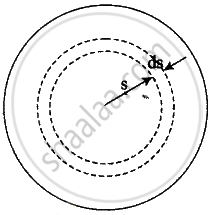
`I^d = int_0^a ((2piI_0)/λ^2 "In" a/s sin 2πνt)2πsds`
= `int_0^a [(2pi)/λ^2 I_0 int_(s = 0)^a "In" (a/s)sds sin 2πvt] xx 2π`
= `((2π)/λ)^2 I_0 int_0^a "In" (a/s) 1/2d(s^2)* sin 2πvt`
= `(a/2)^2 ((2π)/λ)^2 I_0 sin 2πvt int_0^a "In" (a/s)*d(s/a)^2`
= `a^2/4 ((2π)/λ)^2 I_0 sin 2πvt int_0^a "In" (a/s)*d(s/a)^2`
= `a^2/4 ((2π)/λ)^2 I_0 sin 2πvt xx (1)` .....`[∵ int_(s = 0)^a "In" (s/a)^2 d(s/d)^2 = 1]`
∴ `I_d = a^2/4 ((2π)/λ)^2 I_0 sin 2πvt`
⇒ `I_d = ((πa)/λ)^2 I_0 sin 2πvt`
iii. The displacement current,
Id = `((πa)/λ)^2 I_0 sin 2πvt = I_0^d sin 2πvt`
Here, `I_0^d ((aπ)/λ)^2 I_0`
⇒ `I_0^d/I_0 = ((aπ)/λ)^2`
APPEARS IN
RELATED QUESTIONS
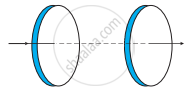
Figure shows a capacitor made of two circular plates each of radius 12 cm, and separated by 5.0 cm. The capacitor is being charged by an external source (not shown in the figure). The charging current is constant and equal to 0.15 A.
- Calculate the capacitance and the rate of charge of the potential difference between the plates.
- Obtain the displacement current across the plates.
- Is Kirchhoff’s first rule (junction rule) valid at each plate of the capacitor? Explain.
When an ideal capacitor is charged by a dc battery, no current flows. However, when an ac source is used, the current flows continuously. How does one explain this, based on the concept of displacement current?
A parallel-plate capacitor of plate-area A and plate separation d is joined to a battery of emf ε and internal resistance R at t = 0. Consider a plane surface of area A/2, parallel to the plates and situated symmetrically between them. Find the displacement current through this surface as a function of time.
Without the concept of displacement current it is not possible to correctly apply Ampere’s law on a path parallel to the plates of parallel plate capacitor having capacitance C in ______.
Displacement current is given by ______.
If the total energy of a particle executing SHM is E, then the potential energy V and the kinetic energy K of the particle in terms of E when its displacement is half of its amplitude will be ______.
Displacement current goes through the gap between the plantes of a capacitors. When the charge of the capacitor:-
A capacitor of capacitance ‘C’, is connected across an ac source of voltage V, given by V = V0 sinωt The displacement current between the plates of the capacitor would then be given by ______
Show that average value of radiant flux density ‘S’ over a single period ‘T’ is given by S = `1/(2cmu_0) E_0^2`.
You are given a 2 µF parallel plate capacitor. How would you establish an instantaneous displacement current of 1 mA in the space between its plates?
Sea water at frequency ν = 4 × 10⁸ Hz has permittivity ε ≈ 80 εo, permeability µ ≈ µo and resistivity ρ = 0.25 Ω–m. Imagine a parallel plate capacitor immersed in seawater and driven by an alternating voltage source V(t) = Vo sin (2πνt). What fraction of the conduction current density is the displacement current density?
AC voltage V(t) = 20 sinωt of frequency 50 Hz is applied to a parallel plate capacitor. The separation between the plates is 2 mm and the area is 1 m2. The amplitude of the oscillating displacement current for the applied AC voltage is ______.
[take ε0 = 8.85 × 10⁻¹² F/m]
Draw a neat labelled diagram of displacement current in the space between the plates of the capacitor.
A parallel plate capacitor made of circular plates is being charged such that the surface charge density on its palates is increasing at a constant rate with time. The magnetic field arising due to displacement current is ______.
A parallel plate capacitor is charged by connecting it to a battery through a resistor. If I is the current in the circuit, then in the gap between the plates, there is no conduction current:
In the Ampere–Maxwell Circuital Law, what produces a changing magnetic field in addition to current?
What does Faraday's Law establish in the comparison with displacement current?
How does displacement current apply when charging a smartphone?
What role does displacement current have in radio wave transmission?
