Advertisements
Advertisements
प्रश्न
A long straight cable of length `l` is placed symmetrically along z-axis and has radius a(<< l). The cable consists of a thin wire and a co-axial conducting tube. An alternating current I(t) = I0 sin (2πνt) flows down the central thin wire and returns along the co-axial conducting tube. The induced electric field at a distance s from the wire inside the cable is E(s,t) = µ0I0ν cos (2πνt) In `(s/a)hatk`.
- Calculate the displacement current density inside the cable.
- Integrate the displacement current density across the cross-section of the cable to find the total displacement current Id.
- Compare the conduction current I0 with the displacement current `I_0^d`.
Advertisements
उत्तर
i. Induced electric field E(s, t) at distance s(s < radius of co-axial cable) is given as E(s, t) = ε0I0v cos 2πνt `log_e (s/a) hatk`. Displacement current density Id is given by
Jd = `ε_0 (dE)/(dt) = ε_0mu_0I_0 v d/(dt) [cos 2πνt. log_e (s/a)]hatk`
Jd = `ε_0mu_0I_0v [(- sin 2πνt) .2πν. log_e (s/a)]hatk` ......[∵ s and a are constant]
Jd = `-ε_0mu_0I_02πν^2 log_e (s/a) (sin 2πνt) hatk`
= `-1/C_0 I_02πν^2 log_e (a*s) (sin 2πνt) hatk` ......`[∵ C = 1/sqrt(mu_0ε_0)]`
= `+ (2πν^2)/C^2 I_0 log_e (a/s) sin 2πνt hatk`
= `(2πν^2)/(v^2λ^2) I_0 log_e (a/s) sin 2πνhatk`
| Jd = `(2πl_0)/λ^2 log_e a/s sin(2πνt)hatk` |
ii. Total displacement current, `I^d = int J_d 2πsds`
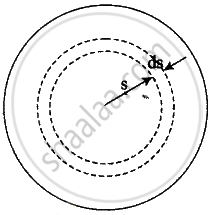
`I^d = int_0^a ((2piI_0)/λ^2 "In" a/s sin 2πνt)2πsds`
= `int_0^a [(2pi)/λ^2 I_0 int_(s = 0)^a "In" (a/s)sds sin 2πvt] xx 2π`
= `((2π)/λ)^2 I_0 int_0^a "In" (a/s) 1/2d(s^2)* sin 2πvt`
= `(a/2)^2 ((2π)/λ)^2 I_0 sin 2πvt int_0^a "In" (a/s)*d(s/a)^2`
= `a^2/4 ((2π)/λ)^2 I_0 sin 2πvt int_0^a "In" (a/s)*d(s/a)^2`
= `a^2/4 ((2π)/λ)^2 I_0 sin 2πvt xx (1)` .....`[∵ int_(s = 0)^a "In" (s/a)^2 d(s/d)^2 = 1]`
∴ `I_d = a^2/4 ((2π)/λ)^2 I_0 sin 2πvt`
⇒ `I_d = ((πa)/λ)^2 I_0 sin 2πvt`
iii. The displacement current,
Id = `((πa)/λ)^2 I_0 sin 2πvt = I_0^d sin 2πvt`
Here, `I_0^d ((aπ)/λ)^2 I_0`
⇒ `I_0^d/I_0 = ((aπ)/λ)^2`
APPEARS IN
संबंधित प्रश्न
The charging current for a capacitor is 0.25 A. What is the displacement current across its plates?
A parallel-plate capacitor of plate-area A and plate separation d is joined to a battery of emf ε and internal resistance R at t = 0. Consider a plane surface of area A/2, parallel to the plates and situated symmetrically between them. Find the displacement current through this surface as a function of time.
If the total energy of a particle executing SHM is E, then the potential energy V and the kinetic energy K of the particle in terms of E when its displacement is half of its amplitude will be ______.
Which of the following is the unit of displacement current?
A parallel plate capacitor of plate separation 2 mm is connected in an electric circuit having source voltage 400 V. What is the value of the displacement current for 10-6 second if the plate area is 60 cm2?
According to Maxwell's hypothesis, a changing electric field gives rise to ______.
The charge on a parallel plate capacitor varies as q = q0 cos 2πνt. The plates are very large and close together (area = A, separation = d). Neglecting the edge effects, find the displacement current through the capacitor?
A variable frequency a.c source is connected to a capacitor. How will the displacement current change with decrease in frequency?
Show that the magnetic field B at a point in between the plates of a parallel-plate capacitor during charging is `(ε_0mu_r)/2 (dE)/(dt)` (symbols having usual meaning).
Show that average value of radiant flux density ‘S’ over a single period ‘T’ is given by S = `1/(2cmu_0) E_0^2`.
A parallel plate capacitor is charged to 100 × 10-6 C. Due to radiations, falling from a radiating source, the plate loses charge at the rate of 2 × 10⁻⁷ Cs-1. The magnitude of displacement current is ______.
Draw a neat labelled diagram of displacement current in the space between the plates of the capacitor.
In the Ampere–Maxwell Circuital Law, what produces a changing magnetic field in addition to current?
Where does conduction current flow as the capacitor charges?
For the charging capacitor, what does \[\varepsilon_0\frac{d\Phi_E}{dt}\] equal?
How does displacement current apply when charging a smartphone?
How is displacement current relevant to MRI machines?
