Advertisements
Advertisements
प्रश्न
An electromagnetic wave travelling along z-axis is given as: E = E0 cos (kz – ωt.). Choose the correct options from the following;
- The associated magnetic field is given as `B = 1/c hatk xx E = 1/ω (hatk xx E)`.
- The electromagnetic field can be written in terms of the associated magnetic field as `E = c(B xx hatk)`.
- `hatk.E = 0, hatk.B` = 0.
- `hatk xx E = 0, hatk xx B` = 0.
पर्याय
a, b and c
a, c and d
b, c and d
b and d
Advertisements
उत्तर
a, b and c
Explanation:
a. The direction of propagation of an electromagnetic wave is always along the direction of vector product `vecE xx vecB`. Refer to figure.
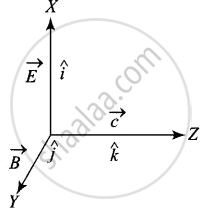
`vecB = Bhatj = B(hatk xx hati) = E/c (hatk xx hati)`
= `1/c [k xx Ehati] = 1/c [hatk xx vecE]` .....`("as" E/B = c)`
b. `vecE = Ehati = cB(hatj xx hatk) = c(Bhatj xx hatk) = c(vecB xx hatk)`
c. `hatk * vecE = hatk * (Ehati)` = 0, `veck * vecB = hatk * (Bhatj)` = 0
d. `hatk xx vecE = hatk xx (Ehati) = E(hatk xx hati) = Ehatj` and `hatk xx vecB = hatk xx (Bhatj) = B(hatk xx hatj) = - Bhati`
APPEARS IN
संबंधित प्रश्न
The charging current for a capacitor is 0.25 A. What is the displacement current across its plates?
A capacitor has been charged by a dc source. What are the magnitude of conduction and displacement current, when it is fully charged?
When an ideal capacitor is charged by a dc battery, no current flows. However, when an ac source is used, the current flows continuously. How does one explain this, based on the concept of displacement current?
A parallel-plate capacitor of plate-area A and plate separation d is joined to a battery of emf ε and internal resistance R at t = 0. Consider a plane surface of area A/2, parallel to the plates and situated symmetrically between them. Find the displacement current through this surface as a function of time.
If the total energy of a particle executing SHM is E, then the potential energy V and the kinetic energy K of the particle in terms of E when its displacement is half of its amplitude will be ______.
The displacement of a particle from its mean position is given by x = 4 sin (10πt + 1.5π) cos (10πt + 1.5π). The motion of the particle is
According to Maxwell's hypothesis, a changing electric field gives rise to ______.
Show that average value of radiant flux density ‘S’ over a single period ‘T’ is given by S = `1/(2cmu_0) E_0^2`.
A parallel plate capacitor is charged to 100 × 10-6 C. Due to radiations, falling from a radiating source, the plate loses charge at the rate of 2 × 10⁻⁷ Cs-1. The magnitude of displacement current is ______.
A parallel plate capacitor made of circular plates is being charged such that the surface charge density on its palates is increasing at a constant rate with time. The magnetic field arising due to displacement current is ______.
What is displacement current?
Which condition indicates that displacement current exists?
What is occurring between the plates of a charging capacitor despite there being no net charge movement through the gap?
What magnetic effect did Maxwell propose for a time-varying electric field?
What does Faraday's Law establish in the comparison with displacement current?
For the charging capacitor, what does \[\varepsilon_0\frac{d\Phi_E}{dt}\] equal?
How do displacement current and conduction current compare in the charging capacitor?
How is displacement current relevant to MRI machines?
