Advertisements
Advertisements
प्रश्न
An electromagnetic wave travelling along z-axis is given as: E = E0 cos (kz – ωt.). Choose the correct options from the following;
- The associated magnetic field is given as `B = 1/c hatk xx E = 1/ω (hatk xx E)`.
- The electromagnetic field can be written in terms of the associated magnetic field as `E = c(B xx hatk)`.
- `hatk.E = 0, hatk.B` = 0.
- `hatk xx E = 0, hatk xx B` = 0.
विकल्प
a, b and c
a, c and d
b, c and d
b and d
Advertisements
उत्तर
a, b and c
Explanation:
a. The direction of propagation of an electromagnetic wave is always along the direction of vector product `vecE xx vecB`. Refer to figure.
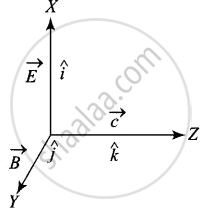
`vecB = Bhatj = B(hatk xx hati) = E/c (hatk xx hati)`
= `1/c [k xx Ehati] = 1/c [hatk xx vecE]` .....`("as" E/B = c)`
b. `vecE = Ehati = cB(hatj xx hatk) = c(Bhatj xx hatk) = c(vecB xx hatk)`
c. `hatk * vecE = hatk * (Ehati)` = 0, `veck * vecB = hatk * (Bhatj)` = 0
d. `hatk xx vecE = hatk xx (Ehati) = E(hatk xx hati) = Ehatj` and `hatk xx vecB = hatk xx (Bhatj) = B(hatk xx hatj) = - Bhati`
APPEARS IN
संबंधित प्रश्न
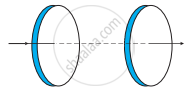
Figure shows a capacitor made of two circular plates each of radius 12 cm, and separated by 5.0 cm. The capacitor is being charged by an external source (not shown in the figure). The charging current is constant and equal to 0.15 A.
- Calculate the capacitance and the rate of charge of the potential difference between the plates.
- Obtain the displacement current across the plates.
- Is Kirchhoff’s first rule (junction rule) valid at each plate of the capacitor? Explain.
The charging current for a capacitor is 0.25 A. What is the displacement current across its plates?
A parallel-plate capacitor of plate-area A and plate separation d is joined to a battery of emf ε and internal resistance R at t = 0. Consider a plane surface of area A/2, parallel to the plates and situated symmetrically between them. Find the displacement current through this surface as a function of time.
Displacement current is given by ______.
If the total energy of a particle executing SHM is E, then the potential energy V and the kinetic energy K of the particle in terms of E when its displacement is half of its amplitude will be ______.
A spring balance has a scale that reads 0 to 50 kg. The length of the scale is 20 cm. A body suspended from this spring, when displaced and released, oscillates with a period of 0.60 s. What is the weight of the body?
A cylinder of radius R, length Land density p floats upright in a fluid of density p0. The cylinder is given a gentle downward push as a result of which there is a vertical displacement of size x; it is then released; the time period of resulting (undampe (D) oscillations is ______.
The displacement of a particle from its mean position is given by x = 4 sin (10πt + 1.5π) cos (10πt + 1.5π). The motion of the particle is
Displacement current goes through the gap between the plantes of a capacitors. When the charge of the capacitor:-
A capacitor of capacitance ‘C’, is connected across an ac source of voltage V, given by V = V0 sinωt The displacement current between the plates of the capacitor would then be given by ______
Show that the magnetic field B at a point in between the plates of a parallel-plate capacitor during charging is `(ε_0mu_r)/2 (dE)/(dt)` (symbols having usual meaning).
Show that average value of radiant flux density ‘S’ over a single period ‘T’ is given by S = `1/(2cmu_0) E_0^2`.
AC voltage V(t) = 20 sinωt of frequency 50 Hz is applied to a parallel plate capacitor. The separation between the plates is 2 mm and the area is 1 m2. The amplitude of the oscillating displacement current for the applied AC voltage is ______.
[take ε0 = 8.85 × 10⁻¹² F/m]
A parallel plate capacitor is charged to 100 × 10-6 C. Due to radiations, falling from a radiating source, the plate loses charge at the rate of 2 × 10⁻⁷ Cs-1. The magnitude of displacement current is ______.
Draw a neat labelled diagram of displacement current in the space between the plates of the capacitor.
