Advertisements
Advertisements
प्रश्न
A capacitor has been charged by a dc source. What are the magnitude of conduction and displacement current, when it is fully charged?
Advertisements
उत्तर
Elecric flux through plates of capacitor, `φ_E = q/ε_o`.
Here, q = constant, the capacitor is fully charged.
Displacement current , `I_D= ε_o (dφ_E)/dt = ε_od((q/ε_o)/dt) = 0 `
Contduction current, `I = c (dv)/dt = 0` as volatage becomes constant
when the capacitor becomes fully charged.
APPEARS IN
संबंधित प्रश्न
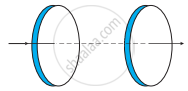
Figure shows a capacitor made of two circular plates each of radius 12 cm, and separated by 5.0 cm. The capacitor is being charged by an external source (not shown in the figure). The charging current is constant and equal to 0.15 A.
- Calculate the capacitance and the rate of charge of the potential difference between the plates.
- Obtain the displacement current across the plates.
- Is Kirchhoff’s first rule (junction rule) valid at each plate of the capacitor? Explain.
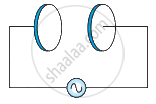
A parallel plate capacitor (Figure) made of circular plates each of radius R = 6.0 cm has a capacitance C = 100 pF. The capacitor is connected to a 230 V ac supply with a (angular) frequency of 300 rad s−1.
- What is the rms value of the conduction current?
- Is the conduction current equal to the displacement current?
- Determine the amplitude of B at a point 3.0 cm from the axis between the plates.
Without the concept of displacement current it is not possible to correctly apply Ampere’s law on a path parallel to the plates of parallel plate capacitor having capacitance C in ______.
A cylinder of radius R, length Land density p floats upright in a fluid of density p0. The cylinder is given a gentle downward push as a result of which there is a vertical displacement of size x; it is then released; the time period of resulting (undampe (D) oscillations is ______.
The charge on a parallel plate capacitor varies as q = q0 cos 2πνt. The plates are very large and close together (area = A, separation = d). Neglecting the edge effects, find the displacement current through the capacitor?
Sea water at frequency ν = 4 × 10⁸ Hz has permittivity ε ≈ 80 εo, permeability µ ≈ µo and resistivity ρ = 0.25 Ω–m. Imagine a parallel plate capacitor immersed in seawater and driven by an alternating voltage source V(t) = Vo sin (2πνt). What fraction of the conduction current density is the displacement current density?
What is displacement current?
What is occurring between the plates of a charging capacitor despite there being no net charge movement through the gap?
What magnetic effect did Maxwell propose for a time-varying electric field?
In the relay-race analogy, what picks up the baton when conduction current in the wire stops?
