Advertisements
Advertisements
प्रश्न
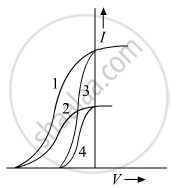
The given graph shows the variation of photo-electric current (I) versus applied voltage (V) for two difference photosensitive materials and for two different intensities of the incident radiations. Identify the pairs of curves that correspond to different materials but same intensity of incident radiation.
Advertisements
उत्तर
Curves 1 and 2 correspond to similar materials while curves 3 and 4 represent different materials, since the value of stopping potential for the pair of curves (1 and 2) & (3 and 4) are the same. For given frequency of the incident radiation the stopping potential is independent of its intensity.
So, the pairs of curves (1 and 3) and (2 and 4) correspond to different materials but same intensity of incident radiation.
APPEARS IN
संबंधित प्रश्न
A device X is connected across an ac source of voltage V = V0 sin ωt. The current through X is given as
`I = I_0 sin (omega t + pi/2 )`
1) Identify the device X and write the expression for its reactance.
2) Draw graphs showing the variation of voltage and current with time over one cycle of ac, for X.
3) How does the reactance of the device X vary with the frequency of the ac? Show this variation graphically.
4) Draw the phasor diagram for the device X.
Two alternating currents are given by `i_1 = i_0 sin wt and i_2 = i_0 sin (wt + pi/3)` Will the rms values of the currents be equal or different?
An alternating current is given by i = i1 cos ωt + i2 sin ωt. The rms current is given by
The household supply of electricity is at 220 V (rms value) and 50 Hz. Find the peak voltage and the least possible time in which the voltage can change from the rms value to zero.
The dielectric strength of air is 3.0 × 10⁶ V/m. A parallel-plate air-capacitor has area 20 cm2 and plate separation 0.10 mm. Find the maximum rms voltage of an AC source that can be safely connected to this capacitor.
A coil of inductance 5.0 mH and negligible resistance is connected to the oscillator of the previous problem. Find the peak currents in the circuit for ω = 100 s−1, 500 s−1, 1000 s−1.
Answer the following question.
A small town with a demand of 1200 kW of electric power at 220 V is situated 20 km away from an electric plant generating power at 440 V. The resistance of the two wirelines carrying power is 0.5 Ω per km. The town gets the power from the line through a 4000-220 V step-down transformer at a sub-station in the town. Estimate the line power loss in the form of heat.
The rms value of current in an ac circuit is 10 A. What is the peak current?
In a transformer Np = 500, Ns = 5000. Input voltage is 20 volt and frequency is 50 HZ. Then in the output, we have,
The output of a step-down transformer is measured to be 24 V when connected to a 12-watt light bulb. The value of the peak current is ______.
