Advertisements
Advertisements
प्रश्न
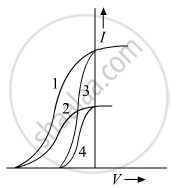
The given graph shows the variation of photo-electric current (I) versus applied voltage (V) for two difference photosensitive materials and for two different intensities of the incident radiations. Identify the pairs of curves that correspond to different materials but same intensity of incident radiation.
Advertisements
उत्तर
Curves 1 and 2 correspond to similar materials while curves 3 and 4 represent different materials, since the value of stopping potential for the pair of curves (1 and 2) & (3 and 4) are the same. For given frequency of the incident radiation the stopping potential is independent of its intensity.
So, the pairs of curves (1 and 3) and (2 and 4) correspond to different materials but same intensity of incident radiation.
APPEARS IN
संबंधित प्रश्न
An alternating current of peak value 14 A is used to heat a metal wire. To produce the same heating effect, a constant current i can be used, where i is
A constant current of 2.8 A exists in a resistor. The rms current is
Find the time required for a 50 Hz alternating current to change its value from zero to the rms value.
An electric bulb is designed to operate at 12 volts DC. If this bulb is connected to an AC source and gives normal brightness, what would be the peak voltage of the source?
A resistor of resistance 100 Ω is connected to an AC source ε = (12 V) sin (250 π s−1)t. Find the energy dissipated as heat during t = 0 to t = 1.0 ms.
The peak voltage of an ac supply is 300 V. What is the rms voltage?
The rms value of current in an ac circuit is 10 A. What is the peak current?
In a transformer Np = 500, Ns = 5000. Input voltage is 20 volt and frequency is 50 HZ. Then in the output, we have,
When a voltage measuring device is connected to AC mains, the meter shows the steady input voltage of 220V. This means ______.
RMS value of an alternating current flowing in a circuit is 5A. Calculate its peak value.
