Advertisements
Advertisements
प्रश्न
The charging current for a capacitor is 0.25 A. What is the displacement current across its plates?
Advertisements
उत्तर
APPEARS IN
संबंधित प्रश्न
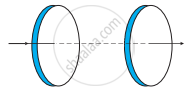
Figure shows a capacitor made of two circular plates each of radius 12 cm, and separated by 5.0 cm. The capacitor is being charged by an external source (not shown in the figure). The charging current is constant and equal to 0.15 A.
- Calculate the capacitance and the rate of charge of the potential difference between the plates.
- Obtain the displacement current across the plates.
- Is Kirchhoff’s first rule (junction rule) valid at each plate of the capacitor? Explain.
A parallel-plate capacitor of plate-area A and plate separation d is joined to a battery of emf ε and internal resistance R at t = 0. Consider a plane surface of area A/2, parallel to the plates and situated symmetrically between them. Find the displacement current through this surface as a function of time.
Displacement current is given by ______.
If the total energy of a particle executing SHM is E, then the potential energy V and the kinetic energy K of the particle in terms of E when its displacement is half of its amplitude will be ______.
According to Maxwell's hypothesis, a changing electric field gives rise to ______.
A capacitor of capacitance ‘C’, is connected across an ac source of voltage V, given by V = V0 sinωt The displacement current between the plates of the capacitor would then be given by ______.
The charge on a parallel plate capacitor varies as q = q0 cos 2πνt. The plates are very large and close together (area = A, separation = d). Neglecting the edge effects, find the displacement current through the capacitor?
A particle is moving with speed v = b`sqrtx` along positive x-axis. Calculate the speed of the particle at time t = τ (assume that the particle is at origin at t = 0).
Draw a neat labelled diagram of displacement current in the space between the plates of the capacitor.
A parallel plate capacitor is charged by connecting it to a battery through a resistor. If I is the current in the circuit, then in the gap between the plates, there is no conduction current:
