Advertisements
Advertisements
प्रश्न
Sea water at frequency ν = 4 × 10⁸ Hz has permittivity ε ≈ 80 εo, permeability µ ≈ µo and resistivity ρ = 0.25 Ω–m. Imagine a parallel plate capacitor immersed in seawater and driven by an alternating voltage source V(t) = Vo sin (2πνt). What fraction of the conduction current density is the displacement current density?
Advertisements
उत्तर
Let the separation between the plates of capacitor immersed in seawater plates is d and applied voltage across the plates is V(t) = V0 sin (2πνt).
Thus, electric field, E = `(V(t))/d`
⇒ E = `V_0/d sin (2πνt)`
Now using Ohm's law, the conduction current density Jc = `E/ρ = 1/ρ V_0/d sin (2πνt)`
⇒ Jc = `V_0/(ρd) sin (2πνt) = J_0^c sin 2πνt`
Here, `J_0^c = V_0/(ρd)`
The displacement current density is given as
Jd = `ε (dE)/(dt) = ε d/(dt) [V_0/d sin (2πνt)]`
= `(ε2πν V_0)/d cos (2πνt)`
⇒ Jd = `J_0^d cos (2πνt)`
Where, `J_0^d = (2πνεV_0)/d`
⇒ `J_0^d/J_0^c = ((2pivεV_0)/d)/((V_0)/(ρd)) = 2πνερ`
= `2pi xx 80ε_0v xx 0.25 = 4piε_0v xx 10`
⇒ `J_0^d/J_0^c = (10 xx 4 xx 10^8)/(9 xx 10^9) = 4/9`
APPEARS IN
संबंधित प्रश्न
A parallel plate capacitor (Figure) made of circular plates each of radius R = 6.0 cm has a capacitance C = 100 pF. The capacitor is connected to a 230 V ac supply with a (angular) frequency of 300 rad s−1.
- What is the rms value of the conduction current?
- Is the conduction current equal to the displacement current?
- Determine the amplitude of B at a point 3.0 cm from the axis between the plates.
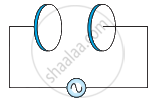
A capacitor has been charged by a dc source. What are the magnitude of conduction and displacement current, when it is fully charged?
When an ideal capacitor is charged by a dc battery, no current flows. However, when an ac source is used, the current flows continuously. How does one explain this, based on the concept of displacement current?
A parallel-plate capacitor of plate-area A and plate separation d is joined to a battery of emf ε and internal resistance R at t = 0. Consider a plane surface of area A/2, parallel to the plates and situated symmetrically between them. Find the displacement current through this surface as a function of time.
Without the concept of displacement current it is not possible to correctly apply Ampere’s law on a path parallel to the plates of parallel plate capacitor having capacitance C in ______.
Displacement current is given by ______.
A spring balance has a scale that reads 0 to 50 kg. The length of the scale is 20 cm. A body suspended from this spring, when displaced and released, oscillates with a period of 0.60 s. What is the weight of the body?
A parallel plate capacitor of plate separation 2 mm is connected in an electric circuit having source voltage 400 V. What is the value of the displacement current for 10-6 second if the plate area is 60 cm2?
A capacitor of capacitance ‘C’, is connected across an ac source of voltage V, given by V = V0 sinωt The displacement current between the plates of the capacitor would then be given by ______.
A capacitor of capacitance ‘C’, is connected across an ac source of voltage V, given by V = V0 sinωt The displacement current between the plates of the capacitor would then be given by ______
A capacitor of capacitance ‘C’, is connected across an ac source of voltage V, given by
V = V0sinωt
The displacement current between the plates of the capacitor would then be given by:
An electromagnetic wave travelling along z-axis is given as: E = E0 cos (kz – ωt.). Choose the correct options from the following;
- The associated magnetic field is given as `B = 1/c hatk xx E = 1/ω (hatk xx E)`.
- The electromagnetic field can be written in terms of the associated magnetic field as `E = c(B xx hatk)`.
- `hatk.E = 0, hatk.B` = 0.
- `hatk xx E = 0, hatk xx B` = 0.
A variable frequency a.c source is connected to a capacitor. How will the displacement current change with decrease in frequency?
Show that the magnetic field B at a point in between the plates of a parallel-plate capacitor during charging is `(ε_0mu_r)/2 (dE)/(dt)` (symbols having usual meaning).
Show that average value of radiant flux density ‘S’ over a single period ‘T’ is given by S = `1/(2cmu_0) E_0^2`.
You are given a 2 µF parallel plate capacitor. How would you establish an instantaneous displacement current of 1 mA in the space between its plates?
Draw a neat labelled diagram of displacement current in the space between the plates of the capacitor.
