Advertisements
Advertisements
Question
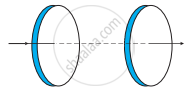
Figure shows a capacitor made of two circular plates each of radius 12 cm, and separated by 5.0 cm. The capacitor is being charged by an external source (not shown in the figure). The charging current is constant and equal to 0.15 A.
- Calculate the capacitance and the rate of charge of the potential difference between the plates.
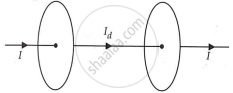
- Obtain the displacement current across the plates.
- Is Kirchhoff’s first rule (junction rule) valid at each plate of the capacitor? Explain.
Advertisements
Solution
Radius of each circular plate, r = 12 cm = 0.12 m
Distance between the plates, d = 5 cm = 0.05 m
Charging current, I = 0.15 A
Permittivity of free space, ε0 = 8.854 × 10⁻¹² C2 N−1 m−2
(a) Capacitance between the two plates is given by the relation,
C = `(ε_0"A")/"d"` .....[∵ A = πr2 = 3.14 × (0.12)2]
= `(8.854 xx 10^-12 xx 3.14 xx (0.12)^2)/0.05`
= 8.01 × 10⁻¹² F
= 8.01 pF
Charge on each plate, q = CV ⇒ V = `"q"/"C"`
`therefore "dV"/"dt" = 1/"C" "dq"/"dt" = 1/"C" "I" ...(because "dq"/"dt" = "I")`
Rate of charge of the potential difference `"dV"/"dt"` = `0.15/(8.01 xx 10^-12)`
= 1.875 × 10⁹ V s−1
(b) Displacement current across the plates,
`"I"_"d" = epsilon_0 ("d"phi_"E")/"dt"`
Where `phi_"E"` is the electric flux passing through a closed loop between the plates.
∵ The electric field E between the plates = `"q"/(epsilon_0 "A")`
∴ If the area of the loop is A then,
`phi_"E" = oint vec("E") * "d" vec("A") = oint "E dA" ....[because vec("E") ⊥ "d" vec("A")]`
`=> phi_"E" = "EA" = "q"/epsilon_0 => ("d"phi_"E")/"dt" = 1/epsilon_0 * "dq"/"dt"`
∴ `"I"_"d" = epsilon_0 1/epsilon_0 "dq"/"dt" = "I"`
⇒ Displacement current, `"I"_"d"` = 0.15 A
(c) Yes, Kirchhoff's first law is very much applicable to each plate of capacitor as Id = I.
So current is continuous and constant across each plate.
RELATED QUESTIONS
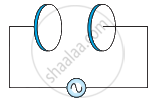
A parallel plate capacitor (Figure) made of circular plates each of radius R = 6.0 cm has a capacitance C = 100 pF. The capacitor is connected to a 230 V ac supply with a (angular) frequency of 300 rad s−1.
- What is the rms value of the conduction current?
- Is the conduction current equal to the displacement current?
- Determine the amplitude of B at a point 3.0 cm from the axis between the plates.
The charging current for a capacitor is 0.25 A. What is the displacement current across its plates?
Without the concept of displacement current it is not possible to correctly apply Ampere’s law on a path parallel to the plates of parallel plate capacitor having capacitance C in ______.
Displacement current is given by ______.
If the total energy of a particle executing SHM is E, then the potential energy V and the kinetic energy K of the particle in terms of E when its displacement is half of its amplitude will be ______.
A spring balance has a scale that reads 0 to 50 kg. The length of the scale is 20 cm. A body suspended from this spring, when displaced and released, oscillates with a period of 0.60 s. What is the weight of the body?
A cylinder of radius R, length Land density p floats upright in a fluid of density p0. The cylinder is given a gentle downward push as a result of which there is a vertical displacement of size x; it is then released; the time period of resulting (undampe (D) oscillations is ______.
The displacement of a particle from its mean position is given by x = 4 sin (10πt + 1.5π) cos (10πt + 1.5π). The motion of the particle is
According to Maxwell's hypothesis, a changing electric field gives rise to ______.
A capacitor of capacitance ‘C’, is connected across an ac source of voltage V, given by V = V0 sinωt The displacement current between the plates of the capacitor would then be given by ______.
A capacitor of capacitance ‘C’, is connected across an ac source of voltage V, given by V = V0 sinωt The displacement current between the plates of the capacitor would then be given by ______
A capacitor of capacitance ‘C’, is connected across an ac source of voltage V, given by
V = V0sinωt
The displacement current between the plates of the capacitor would then be given by:
A variable frequency a.c source is connected to a capacitor. How will the displacement current change with decrease in frequency?
Show that the magnetic field B at a point in between the plates of a parallel-plate capacitor during charging is `(ε_0mu_r)/2 (dE)/(dt)` (symbols having usual meaning).
Sea water at frequency ν = 4 × 10⁸ Hz has permittivity ε ≈ 80 εo, permeability µ ≈ µo and resistivity ρ = 0.25 Ω–m. Imagine a parallel plate capacitor immersed in seawater and driven by an alternating voltage source V(t) = Vo sin (2πνt). What fraction of the conduction current density is the displacement current density?
A particle is moving with speed v = b`sqrtx` along positive x-axis. Calculate the speed of the particle at time t = τ (assume that the particle is at origin at t = 0).
A parallel plate capacitor is charged to 100 × 10-6 C. Due to radiations, falling from a radiating source, the plate loses charge at the rate of 2 × 10⁻⁷ Cs-1. The magnitude of displacement current is ______.
A parallel plate capacitor is charged by connecting it to a battery through a resistor. If I is the current in the circuit, then in the gap between the plates, there is no conduction current:
