Advertisements
Advertisements
प्रश्न
How does one understand this motional emf by invoking the Lorentz force acting on the free charge carriers of the conductor? Explain.
Advertisements
उत्तर
The magnetic force `(qvecvxxvecB)`component of the Lorentz force is responsible for motional electromotive force. When a conductor is moved through a magnetic field, the magnetic force tries to push the free electrons through the wire, and this creates the motional EMF.
APPEARS IN
संबंधित प्रश्न
The figure shows three infinitely long straight parallel current carrying conductors. Find the
- magnitude and direction of the net magnetic field at point A lying on conductor 1,
- magnetic force on conductor 2.

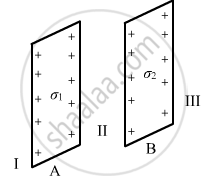
Two infinitely large plane thin parallel sheets having surface charge densities σ1 and σ2 (σ1 > σ2) are shown in the figure. Write the magnitudes and directions of the net fields in the regions marked II and III.
An electron beam projected along the positive x-axis deflects along the positive y-axis. If this deflection is caused by a magnetic field, what is the direction of the field? Can we conclude that the field is parallel to the z-axis?
An electron is moving along the positive x-axis. You want to apply a magnetic field for a short time so that the electron may reverse its direction and move parallel to the negative x-axis. This can be done by applying the magnetic field along
(a) y-axis
(b) z-axis
(c) y-axis only
(d) z-axis only
A long, straight wire of radius R carries a current distributed uniformly over its cross section. T he magnitude of the magnetic field is
(a) maximum at the axis of the wire
(b) minimum at the axis of the wire
(c) maximum at the surface of the wire
(d) minimum at the surface of the wire.
A long, straight wire of radius r carries a current i and is placed horizontally in a uniform magnetic field B pointing vertically upward. The current is uniformly distributed over its cross section. (a) At what points will the resultant magnetic field have maximum magnitude? What will be the maximum magnitude? (b) What will be the minimum magnitude of the resultant magnetic field?
A straight, how wire carries a current of 20 A. Another wire carrying equal current is placed parallel to it. If the force acting on a length of 10 cm of the second wire is 2.0 × 10⁻⁵ N, what is the separation between them?
Do magnetic forces obey Newton’s third law. Verify for two current elements dl1 = dlî located at the origin and dl2 = dlĵ located at (0, R, 0). Both carry current I.
By symmetry, the magnetic field of conductor b exerts a force on conductor a. The relationship between the two forces Fba and Fab is:
The SI unit of the permeability of free space (μ₀) is:
