Advertisements
Advertisements
प्रश्न
Show, via a suitable diagram, how unpolarised light can be polarised by reflection.
Advertisements
उत्तर
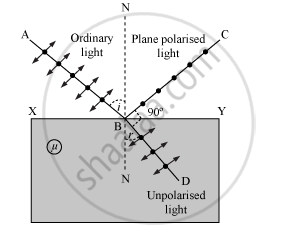
An ordinary beam of light on reflection from a transparent medium becomes partially polarised. The degree of polarisation increases as the angle of incidence is increased. At a particular value of angle of incidence, the reflected beam becomes completely polarised. This angle of incidence is called the polarising angle (p).
When light is incident at polarising angle at the interface of a refracting medium, the refractive index of the medium is equal to the tangent of the polarising angle.
μ = tan p
where
μ → Refractive index of the refracting medium
p → Polarising angle
APPEARS IN
संबंधित प्रश्न
Three identical polaroid sheets P1, P2 and P3 are oriented so that the pass axis of P2 and P3 are inclined at angles of 60° and 90° respectively with the pass axis of P1. A monochromatic source S of unpolarised light of intensity I0 is kept in front of the polaroid sheet P1 as shown in the figure. Determine the intensities of light as observed by the observer at O, when polaroid P3 is rotated with respect to P2 at angles θ = 30° and 60°.

How does one demonstrate, using a suitable diagram, that unpolarised light when passed through a Polaroid gets polarised?
A ray of light is incident on a transparent medium at a polarizing angle. What is the angle between the reflected ray and the refracted ray?
The transverse nature of light is shown in ______.
What is a polariser?
What is plane polarised light?
List the uses of polaroids.
State Brewster’s law.
Which of the following phenomena is not common to sound and light waves?
A polarizer - analyser set is adjusted such that the intensity of light coming out of the analyser is just 10% of the original intensity. Assuming that the polarizer - analyser set does not absorb any light, the angle by which the analyser need to be rotated further to reduce the output intensity to be zero, is ______.
