Advertisements
Advertisements
प्रश्न
A voltage V = V0 sin ωt is applied to a series LCR circuit. Derive the expression for the average power dissipated over a cycle. Under what condition (i) no power is dissipated even though the current flows through the circuit, (ii) maximum power is dissipated in the circuit?
Advertisements
उत्तर
Voltage V=V0sinωt is applied to an series LCR circuit.
Current is π2" role="presentation" style="position: relative;">π2
`I_0=V_0/Z`
`phi=tan^(-1)((X_C-X_L)/R)`
Instantaneous power supplied by the source is
P=VI
=(V0sinωt)×(I0sin(ωt+ϕ)
`=(V_0I_0)/2[cosphi-cos(2omegat+phi)]`
The average power over a cycle is average of the two terms on the R.H.S of the above equation. The second term is time dependent; so, its average is zero.
`P=(V_0I_0)/2cosphi`
`=(V_0I_0)/(sqrt2sqr2)cosphi`
=VIcosϕ
P=I2Zcosϕ
cosϕ is called the power factor.
Case I
For pure inductive circuit or pure capacitive circuit, the phase difference between current and voltage is `pi/2`
`:.phi=pi/2,cosphi=0`
Therefore, no power is dissipated. This current is sometimes referred to as wattless current.
Case II
For power dissipated at resonance in an LCR circuit,
`X_C-X_L=0, phi=0`
∴ cos ϕ = 1
So, maximum power is dissipated.
APPEARS IN
संबंधित प्रश्न
In a series LCR circuit, obtain the condition under which watt-less current flows in the circuit ?
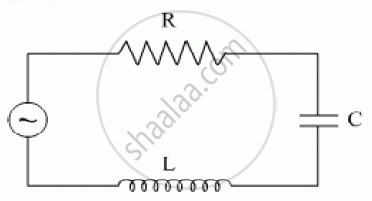
The figure shows a series LCR circuit with L = 10.0 H, C = 40 μF, R = 60 Ω connected to a variable frequency 240 V source, calculate
(i) the angular frequency of the source which drives the circuit at resonance,
(ii) the current at the resonating frequency,
(iii) the rms potential drop across the inductor at resonance.
The potential difference across the resistor is 160V and that across the inductor is 120V. Find the effective value of the applied voltage. If the effective current in the circuit be 1.0 A, calculate the total impedance of the circuit.
Using the phasor diagram, derive the expression for the current flowing in an ideal inductor connected to an a.c. source of voltage, v= vo sin ωt. Hence plot graphs showing the variation of (i) applied voltage and (ii) the current as a function of ωt.
Keeping the source frequency equal to the resonating frequency of the series LCR circuit, if the three elements, L, C and R are arranged in parallel, show that the total current in the parallel LCR circuit is minimum at this frequency. Obtain the current rms value in each branch of the circuit for the elements and source specified for this frequency.
Obtain the resonant frequency and Q-factor of a series LCR circuit with L = 3.0 H, C = 27 µF, and R = 7.4 Ω. It is desired to improve the sharpness of the resonance of the circuit by reducing its ‘full width at half maximum’ by a factor of 2. Suggest a suitable way.
Which of the following components of an LCR circuit, with a.c. supply, dissipates energy?
A 20Ω resistance, 10 mH inductance coil and 15µF capacitor are joined in series. When a suitable frequency alternating current source is joined to this combination, the circuit resonates. If the resistance is made \[\frac {1}{3}\] rd, the resonant frequency ______.
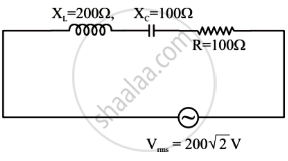
In the given circuit, rms value of current (Irms) through the resistor R is:
Out of the following which one is NOT the characteristic of LCR series resonant circuit?
