Advertisements
Advertisements
Question
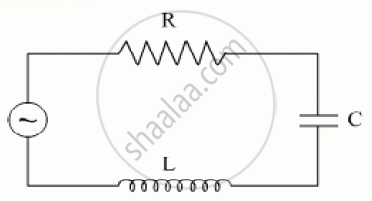
A voltage V = V0 sin ωt is applied to a series LCR circuit. Derive the expression for the average power dissipated over a cycle. Under what condition (i) no power is dissipated even though the current flows through the circuit, (ii) maximum power is dissipated in the circuit?
Advertisements
Solution
Voltage V=V0sinωt is applied to an series LCR circuit.
Current is π2" role="presentation" style="position: relative;">π2
`I_0=V_0/Z`
`phi=tan^(-1)((X_C-X_L)/R)`
Instantaneous power supplied by the source is
P=VI
=(V0sinωt)×(I0sin(ωt+ϕ)
`=(V_0I_0)/2[cosphi-cos(2omegat+phi)]`
The average power over a cycle is average of the two terms on the R.H.S of the above equation. The second term is time dependent; so, its average is zero.
`P=(V_0I_0)/2cosphi`
`=(V_0I_0)/(sqrt2sqr2)cosphi`
=VIcosϕ
P=I2Zcosϕ
cosϕ is called the power factor.
Case I
For pure inductive circuit or pure capacitive circuit, the phase difference between current and voltage is `pi/2`
`:.phi=pi/2,cosphi=0`
Therefore, no power is dissipated. This current is sometimes referred to as wattless current.
Case II
For power dissipated at resonance in an LCR circuit,
`X_C-X_L=0, phi=0`
∴ cos ϕ = 1
So, maximum power is dissipated.
APPEARS IN
RELATED QUESTIONS
The figure shows a series LCR circuit with L = 10.0 H, C = 40 μF, R = 60 Ω connected to a variable frequency 240 V source, calculate
(i) the angular frequency of the source which drives the circuit at resonance,
(ii) the current at the resonating frequency,
(iii) the rms potential drop across the inductor at resonance.
A series LCR circuit is connected to an ac source. Using the phasor diagram, derive the expression for the impedance of the circuit. Plot a graph to show the variation of current with frequency of the source, explaining the nature of its variation.
An inductor of inductance 2.00 H is joined in series with a resistor of resistance 200 Ω and a battery of emf 2.00 V. At t = 10 ms, find (a) the current in the circuit, (b) the power delivered by the battery, (c) the power dissipated in heating the resistor and (d) the rate at which energy is being stored in magnetic field.
In series LCR circuit, the plot of Imax vs ω is shown in figure. Find the bandwidth and mark in the figure.

Define Impedance.
When an alternating voltage of 220V is applied across device X, a current of 0.25A flows which lags behind the applied voltage in phase by π/2 radian. If the same voltage is applied across another device Y, the same current flows but now it is in phase with the applied voltage.
- Name the devices X and Y.
- Calculate the current flowing in the circuit when the same voltage is applied across the series combination of X and Y.
A series LCR circuit is connected to an ac source. Using the phasor diagram, derive the expression for the impedance of the circuit.
Select the most appropriate option with regard to resonance in a series LCR circuit.
To reduce the resonant frequency in an L-C-R series circuit with a generator ______.
To an ac power supply of 220 V at 50 Hz, a resistor of 20 Ω, a capacitor of reactance 25 Ω and an inductor of reactance 45 Ω are connected in series. The corresponding current in the circuit and the phase angle between the current and the voltage is respectively:
