Advertisements
Advertisements
प्रश्न
A parallel plate capacitor of capacitance C is charged to a potential V. It is then connected to another uncharged capacitor having the same capacitance. Find out the ratio of the energy stored in the combined system to that stored initially in the single capacitor.
Advertisements
उत्तर
Let 'q' be the charge on the charged capacitor. Energy stored in it is
`U=q^2/(2C)`
When another similar uncharged capacitor is connected, the net capacitance of the system is C' = 2C
The charge on the system is constant. So, the energy stored in the system now is
`U'=q^2/(2(C"))`
`=>U'=q^2/(2(2C))`
`=>U'=q^2/(4C)`
Thus, the required ratio is
`(U')/U=(q^2/(4C))/(q^2/(2C))`
`=>(U')/U=1/2`
APPEARS IN
संबंधित प्रश्न
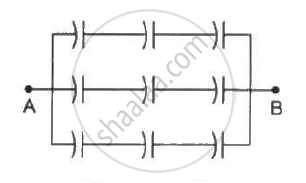
Each of the capacitors shown in figure has a capacitance of 2 µF. find the equivalent capacitance of the assembly between the points A and B. Suppose, a battery of emf 60 volts is connected between A and B. Find the potential difference appearing on the individual capacitors.
A cylindrical capacitor is constructed using two coaxial cylinders of the same length 10 cm and of radii 2 mm and 4 mm. (a) Calculate the capacitance. (b) Another capacitor of the same length is constructed with cylinders of radii 4 mm and 8 mm. Calculate the capacitance.
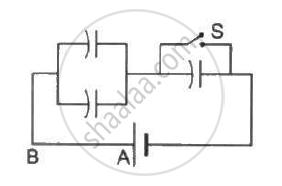
Each capacitor shown in figure has a capacitance of 5⋅0 µF. The emf of the battery is 50 V. How much charge will flow through AB if the switch S is closed?
The separation between the plates of a parallel-plate capacitor is 0⋅500 cm and its plate area is 100 cm2. A 0⋅400 cm thick metal plate is inserted into the gap with its faces parallel to the plates. Show that the capacitance of the assembly is independent of the position of the metal plate within the gap and find its value.
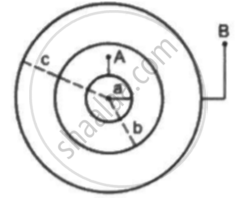
Consider an assembly of three conducting concentric spherical shell of radii a, b and c as shown in figure Find the capacitance of the assembly between the points Aand B.
Three capacitors 2µF, 3µF, and 6µF are joined in series with each other. The equivalent capacitance is ____________.
Between the plates of parallel plate condenser there is 1 mm thick medium shoot of dielectric constant 4. It is charged at 100 volt. The electric field in volt/meter between the plates of capacitor is ______.
In a series combination, which statement describes the potential difference across each capacitor?
What is the practical purpose of a parallel combination of capacitors?
